Managing Risks of Plant
Plant is a major cause of work-related death and injury. Lifecycle duty: design → manufacture → supply → install → use → maintain → dismantle.
Re-baselined against SWA Nov 2024 model edition on 2026-04-28. The Nov 2024 update integrated vehicle roll-away and safe-immobilisation guidance (see §8). Watch state-level amendments — e.g. QLD Work Health and Safety (High Risk Plant) Amendment Regulation 2026 commenced 29 March 2026, moving the "high-risk plant" list from the WHS Act into the Regulation; verify your jurisdiction's adoption.
- Always work down the guarding hierarchy: fixed → interlocked → presence-sensing.
- Lockout-tagout (LOTO) before any cleaning, adjustment, or servicing of moving parts.
- Registrable plant: cranes, tower cranes, hoists, EWPs, pressure vessels, lifts, boilers — design AND item registration.
- HRWL required for forklifts (LF/LO), cranes (CN/CV/CB/CT/CS), dogging (DG), rigging (RB/RI/RA), EWP > 11 m boom (WP), scaffolds (SB/SI/SA), pressure equipment, boilers.
- Plant register + maintenance log are the records a regulator opens first.
1. Definitions
Plant (WHS Reg 5) — any machinery, equipment, appliance, container, implement and tool, plus components and fittings; includes powered and non-powered.
Powered mobile plant — earthmovers, forklifts, cranes, EWPs, telehandlers, skid-steers; specific duties (Reg 215) include FOPS/ROPS, operator restraints, warning devices.
Registrable plant — designs and individual items that must be registered with the regulator before use.
| Category | Design registration | Item registration |
|---|---|---|
| Tower cranes | ✓ | ✓ |
| Mobile cranes (rated > 10 t) | ✓ | ✓ |
| Hoists with cars/cabs | ✓ | ✓ |
| Boom-type EWP > 11 m | ✓ | ✓ |
| Lifts (incl. building / dumb-waiter) | ✓ | ✓ |
| Pressure vessels (high-hazard cat A/B/C) | ✓ | ✓ |
| Boilers | ✓ | ✓ |
| Concrete-placing booms | ✓ | ✓ |
| Amusement devices | ✓ | ✓ |
2. Lifecycle duties (WHS Act ss.21–26)
| Duty holder | Key obligation |
|---|---|
| Designer (s.22) | Design without risks across construction, use, maintenance, dismantling. Provide info downstream. |
| Manufacturer (s.23) | Manufacture per safe design; conduct testing; supply with safe-use info. |
| Importer (s.24) | Same as manufacturer for imported plant. |
| Supplier (s.25) | Provide info on safe use, handling, maintenance, disposal. |
| Installer / commissioner (s.26) | Install / commission such that plant is without risks. |
| User PCBU (s.19) | Operate, maintain, inspect, train, license. |
3. Pre-purchase / pre-use / pre-start
Pre-purchase
- Specify task, environment, capacity, ergonomics, noise/vibration emissions.
- Verify the design is registered (where required); supplier provides design number.
- Get manufacturer manual, SWL/load chart, SDS for any chemicals, manuals in English.
- Check guards/interlocks fitted as standard; arc-flash / FOPS / ROPS specs match exposure.
Pre-use (commissioning)
- Install per manufacturer's instructions; certified competent installer for registrable plant.
- Test all controls, emergency stops, interlocks, brakes, alarms.
- Operator training and competency check before first production use.
- Plant register entry + commissioning record.
Pre-start (each shift)
- Pre-start checklist by competent operator.
- Tyres, brakes, steering, hydraulics, fluid levels, attachments, restraints, alarms, mirrors, lights.
- Sign and date; defects logged + tagged out until repaired.
4. Guarding hierarchy
Always go for the highest level reasonably practicable. A guard that depends on operator behaviour (admin/PPE) is the last layer, not the first.
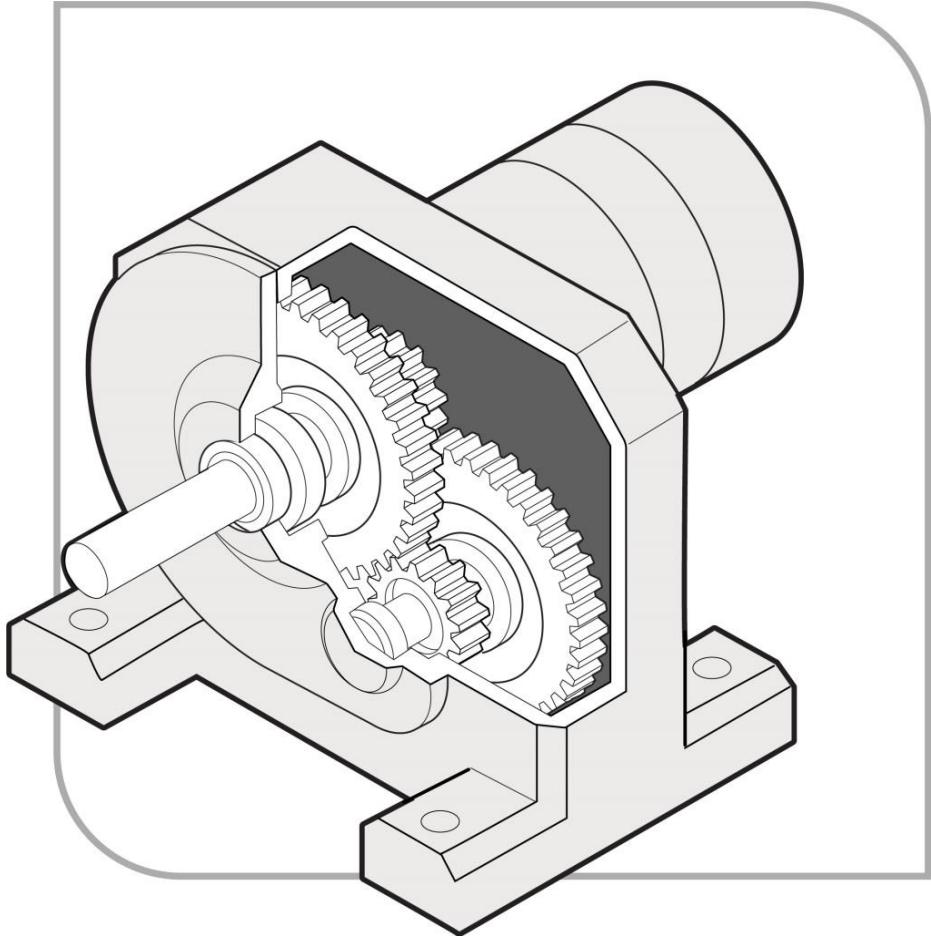 Figure 1 — Fixed barrier guard. The most reliable level: doesn't rely on the operator.
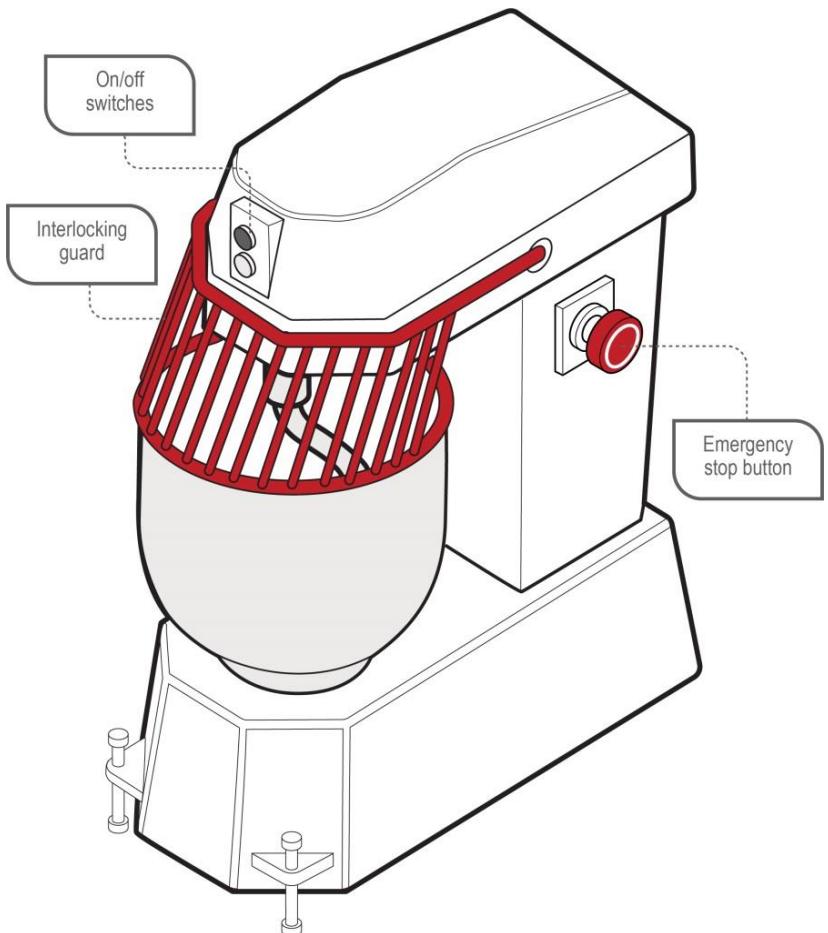 Figure 2 — Interlocked guard. Power is cut when the guard is opened. Standard for accessible moving parts that need regular cleaning/loading.
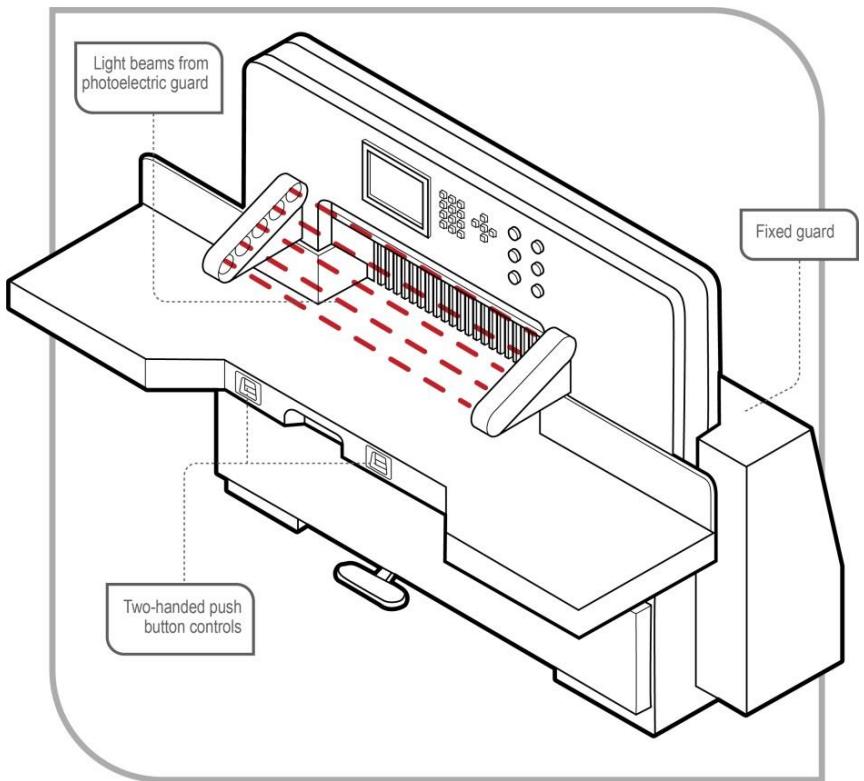 Figure 3 — Presence-sensing (light curtain). Last resort when a fixed/interlocked guard isn't possible. Must be commissioned by a competent person and tested regularly.
Levels (top down)
- Fixed — bolted on; tools required to remove.
- Interlocked — power cuts when guard opens; restart only with deliberate action.
- Tool-fastened removable — for infrequent access (maintenance only).
- Presence-sensing — light curtain, mat, laser scanner. Last resort.
5. Isolation — lockout-tagout (LOTO)
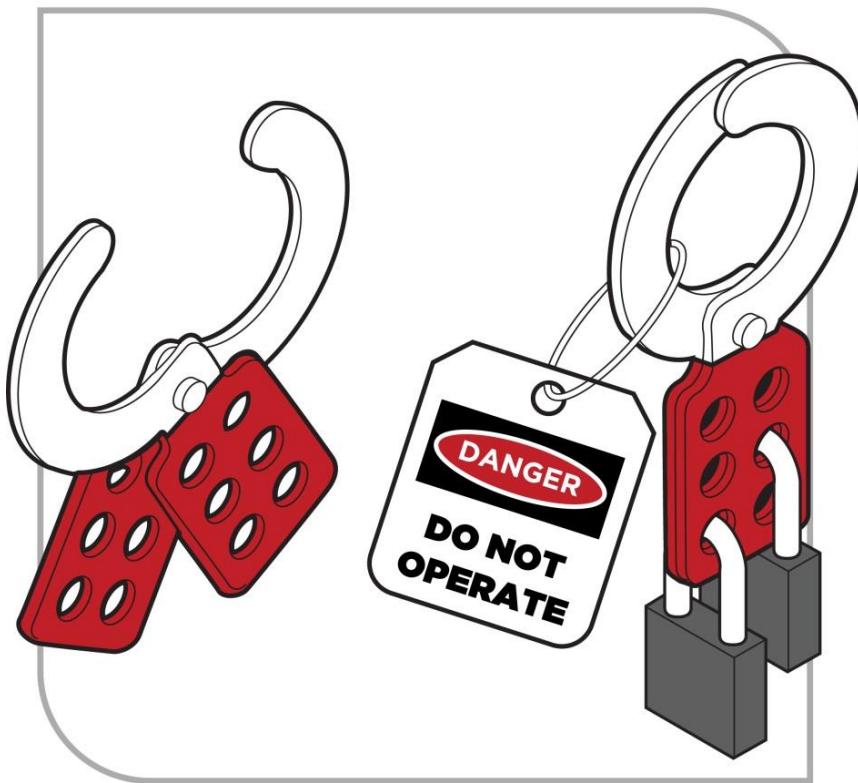 Figure 4 — Lockout-tagout: hasp + multiple personal locks. Each worker applies their own; the last person off removes theirs. The supply cannot be re-energised while any lock remains.
LOTO sequence
- Notify — affected workers / supervisor.
- Shutdown — proper shutdown sequence per the manual.
- Identify — every energy source (electrical, hydraulic, pneumatic, thermal, gravity, stored kinetic, chemical).
- Isolate — open & secure isolators / valves; rack out breakers; physical disconnection where possible.
- Lock & tag — personal lock + danger tag at every isolation point. Tag identifies who, what, why, date.
- Dissipate — bleed pressure, lower elevated parts, dissipate stored energy.
- Test — try to start; verify dead. Re-test if work pauses or worker leaves.
Tags warn; locks isolate. Don't rely on tags alone.
6. High-Risk Work Licences (HRWL)
For construction-relevant plant operation:
| Class | What |
|---|---|
| LF | Forklift truck |
| LO | Order-picking forklift |
| CN | Non-slewing mobile crane > 3 t |
| CV | Vehicle-loading crane (≥ 10 t·m) |
| CB | Slewing mobile crane ≤ 20 t |
| CT | Slewing mobile crane ≤ 60 t |
| CS | Slewing mobile crane ≤ 100 t |
| C2 / C6 / C0 | Tower cranes by capacity / scope |
| DG | Dogging |
| RB / RI / RA | Rigging — basic / intermediate / advanced |
| WP | Boom-type EWP > 11 m |
| SB / SI / SA | Scaffolding — basic / intermediate / advanced |
| HR / HM / HL | Pressure equipment / boiler operation classes |
Verify the licence card before mobilisation — licence numbers are checkable with the regulator.
7. Maintenance, inspection, testing
- Per manufacturer's specs at minimum.
- Competent person for inspections; written record.
- Annual competent-person inspection at minimum for most plant; more frequent for high-use / high-risk.
- Major inspection at intervals specified by manufacturer (10 years typical for cranes).
- Hydraulic / pneumatic systems — pressure-test seals, hoses, rams.
- Lifting gear (slings, hooks, shackles) — visual every use; thorough inspection ≥ every 6 months by competent person; AS 4991 / AS 1418 standards.
8. Construction-site specific
- Site induction must cover plant zones, exclusion zones, communications, site speed limits.
- Spotter for plant operating near workers, near excavation edges (see excavation_work), near services.
- Vehicle roll-away controls (engine off + park brake + steering wheels turned to the kerb on slopes + chock + isolation; park on level surface where possible) — integrated in the SWA Nov 2024 edition; see also SWA fact sheet Preventing vehicle roll-aways and safe immobilisation.
- Refuelling: spark/ignition controls, spill containment, no smoking.
9. Records
- Plant register — type, design number, item number, location, capacity, install date.
- Maintenance log — every service, inspection, test, repair; competent-person sign-off.
- Pre-start checklists — daily; retained for the life of the plant.
- Operator competency / HRWL records — copies on file before mobilisation.
- Incident / defect register — tag-outs, fault findings, close-outs.
- For registered plant: certificate, design / item registration numbers — kept until plant disposed.
10. Common pitfalls / quick wins
Do
- Verify HRWL before anyone climbs into the cab.
- Walk-around pre-start every shift; sign the book.
- LOTO every time the guard goes off; never "just for a minute".
- Keep guards in service — log every removal/reinstatement.
- Tag-out defects immediately; don't wait for the rounds.
- Replace lost manuals — manufacturer or industry-association copies.
Don't
- Operate without a manual on site.
- Assume a generic competency = HRWL. Verify the class.
- Re-energise on someone else's lock. Last person off = last lock off.
- Accept "the supplier will fix it next week" for a defective control. Out of service.
- Run a cleaning cycle without isolating moving parts.
11. Cross-references
- See also: managing_electrical_risks (LOTO of electrical isolation), excavation_work (plant near edges), falls_in_housing_construction / managing_risk_of_falls (EWPs)
- Foundations: risk_management_process
- Glossary (HRWL, LOTO, registrable plant): glossary_and_key_concepts
Source: model_code_of_practice-managing_the_risks_of_plant_in_the_workplace-nov24.pdf (Safe Work Australia, model Code of Practice, CC-BY-NC 4.0). Source edition: November 2024. Last verified against SWA: 2026-04-28. State-level: QLD High Risk Plant Amendment Regulation 2026 commenced 29 March 2026.