Managing Risks in Stevedoring
Wharf / cargo-handling code. Included in this framework for completeness — Saiyu's day-to-day construction work doesn't intersect with stevedoring directly, but multi-PCBU coordination on a wharf is the same in principle as on a construction site, and several techniques (suspended loads, container stacking, confined-space cargo holds) overlap with construction-adjacent work.
- Stevedoring serious-incident rate is ~3× the all-industry average.
- Multi-PCBU coordination between ship operator + stevedoring contractor + wharf operator is the heart of the code.
- Doggers / riggers require HRWL; competent communication with crane operator is a leading indicator of safe operations.
- Cargo holds may be confined spaces — apply confined_spaces permits, testing, isolation, stand-by, rescue.
- Lashing / unlashing has long been the deadliest task. Never alone; level surface; lashbacks lethal.
1. Scope
Loading / unloading vessel cargo, stacking on wharves, terminal operations. All cargo types: containers, RoRo, pure car carrier (PCC), break bulk, bulk, passenger.
2. Multi-PCBU framework (the central issue)
Three primary duty holders with overlapping duty:
| PCBU | Domain |
|---|---|
| Ship operator | Vessel safety, certification, equipment maintenance |
| Stevedoring contractor | Cargo handling, worker supervision, safe systems |
| Wharf / port operator | Infrastructure, traffic management, facilities |
Reg 309-style coordination: pre-arrival planning, shared vessel inspections, exchange of safety information, agreed escalation for outstanding defects.
See whs_consultation_cooperation_coordination — the principles are identical to a construction site with a Principal Contractor + subbies + utilities.
3. Key hazards & controls
Falls between vessel and wharf
- Hazard: gangway gap, unstable steps, height differences with tide.
- Controls: ship-shore gangway clear of crane track and load paths; secured; railings; lighting.
Working at height — container tops, hatches, holds
- Personnel cradles / work boxes with secondary hoisting and emergency stops.
- Continuous comms with crane operator.
- Ladder access in holds: max 6.5 m, 70–80° angle, secured.
Slung / suspended loads
- Doggers / riggers HRWL mandatory; assess load condition and sling method before lift.
- Pre-operational crane inspection.
- Exclusion zones; SWL verification.
- Reliable comms (radio + hand signal redundancy).
Mobile plant — forklifts, straddle carriers, reach stackers, RTGs
- Traffic management plan; pedestrian / vehicle separation.
- Speed limits; marked walkways; designated safe standing for truck drivers.
- Reversing cameras / mirrors / alarms.
- HRWL operators only; pre-operational checks.
Confined spaces (cargo holds)
- Atmospheric testing pre-entry; ventilation; rescue plan.
- Cargo-related gases: residues from prior loads, fumigation, off-gassing.
- See confined_spaces.
Container-specific risks
- Twist-lock failure, improper lashing, integrity compromise.
- Visual inspection of twist-locks for damage; compatibility check with plant.
- Lashing certification (Marine Order 42).
- Reefer cables: unplugged + stowed before discharge; power isolated during lashing.
Lashing / unlashing
- Manual handling strain, lashback injuries (cause of multiple fatalities), double handling, falls on deck.
- Controls: never alone; positioned to avoid lashback; level, stable surface; hatch covers pinned.
- Lashing bars never left hanging; rods stored safely off walkways.
- Two parallel railings around hatches (top + mid-rail, 1 m, taut, 2.5 m spacing).
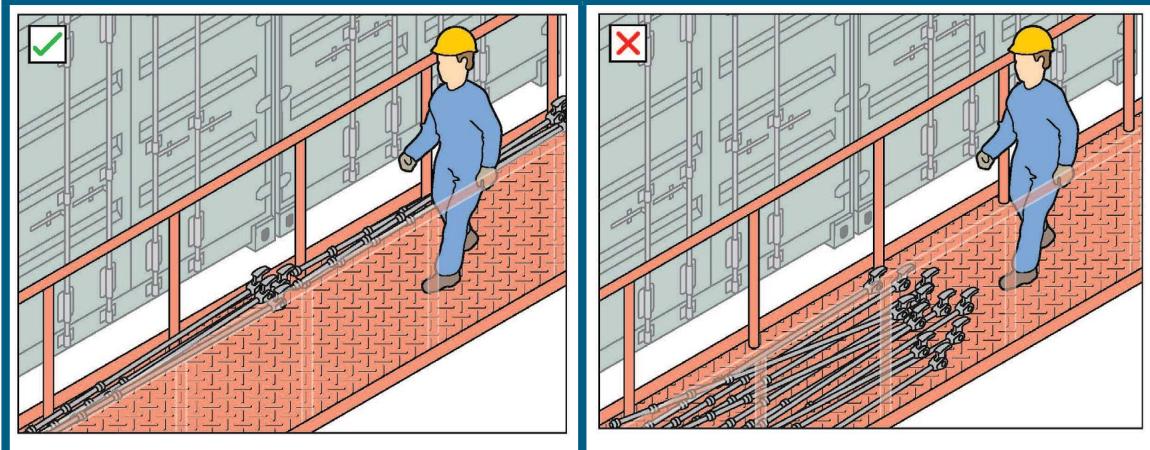 Figure 1 — Lashing-bar storage. Out of walkway, accessible, sorted by length. Trip hazards on deck were a major contributor to past fatalities.
Weather, fatigue, shift work
- High winds — crane operations cease (per crane manufacturer threshold).
- Lightning / poor visibility / rain — work pause + shelter.
- Heat / UV / cold — PPE, water, breaks.
- Fatigue management — break schedules, irregular shift handling.
Atmospheric hazards (holds)
- Fumigation residues, combustion emissions in poorly ventilated holds, dust from bulk cargo.
- Ventilation confirmed before entry; SDS access for known cargoes; no combustion engines in poorly ventilated spaces.
Noise (engines, plant, transmission in holds)
- Noise monitoring; audiometric testing where exposure exceeds standard. See managing_noise_and_preventing_hearing_loss.
Electrical (reefer containers)
- Live cables near work; shock / burn risk during lashing.
- Power disconnection in proximity; cable management protocols.
4. Special equipment & procedures
- Ship-shore gangways: positioned clear of crane track; secured; properly rigged with railings.
- Securing fittings & lashing: Marine Order 42 compliance; certifications; visual inspection systems.
- Crane personnel cradles / work boxes: secondary safety system, emergency stops, SWL marked, full-body harnesses, continuous comms.
- Doggers / riggers: HRWL; sling SWL calculations; load communication.
- Vessel inspections: pre-arrival checklists; condition assessment of gear, housekeeping, cargo presentation.
- Emergency plans: site-specific, crew coordination, evacuation procedures, first aid, comms backup.
5. Records & training
- Plant register: maintenance, inspection, testing, defect documentation, critical safety instructions.
- Training records: stevedoring-specific (duties, hazards, incident reporting, communication, plant operation, emergency, PPE).
- Competency: supervisors, operators, doggers/riggers, plant inspectors.
- HRWL: dogging, rigging, crane, reach stacker / forklift.
- Refresher training schedule — workforce is transient; documented induction is essential.
6. Common pitfalls / quick wins
Do
- Pre-arrival plan with the ship operator; agreed defect escalation path.
- Lash / unlash in pairs; dedicated lookout in holds.
- Tag out damaged lifting gear immediately.
- Enforce wind-speed cease-work on cranes per manufacturer threshold.
- Document toolbox talks; track competency for transient labour.
- Apply confined-space permit + atmospheric test before any hold entry.
Don't
- Run lone-worker lashing operations.
- Conceal or defer reporting equipment defects to keep schedule.
- Skip housekeeping; lashing-bar trips have killed people during vessel motion.
- Assume the principal contractor (stevedoring contractor) covers your duties — each PCBU retains theirs.
- Treat reefer cables as inert during lashing.
7. Cross-references
- 3C duties (multi-PCBU on a wharf): whs_consultation_cooperation_coordination
- Confined-space cargo holds: confined_spaces
- Plant: managing_risks_of_plant
- Falls (between vessel & wharf, container tops): managing_risk_of_falls
- Manual handling (lashing, container handling): hazardous_manual_tasks
- Noise (engines, plant in holds): managing_noise_and_preventing_hearing_loss
- Glossary (HRWL, dogging, rigging): glossary_and_key_concepts
Source: managing_risks_in_stevedoring.md (Safe Work Australia, model Code of Practice, CC-BY-NC 4.0). Edition: December 2016. Last verified against SWA: 2026-04-27.