Managing Risks of Hazardous Chemicals
Identify → label → SDS → register → store/segregate → control. Five steps that map directly to the WHS Regulations Part 7.1.
- GHS 7 is mandatory for new labelling (since 1 Jan 2023).
- Register every hazardous chemical; manifest when Schedule 11 placard quantity exceeded.
- WES absolute duty (Reg 49) — must not be exceeded; not "reasonably practicable".
- Health monitoring mandatory for ongoing exposure to Schedule 14 chemicals.
- Records held 30 years (40 for asbestos).
1. Definition (Reg 5)
A hazardous chemical is a substance, mixture or article that satisfies GHS criteria — including:
- Health hazards: acute / chronic toxicity, carcinogenic, reproductive, sensitiser, target-organ.
- Physical hazards: flammable, oxidising, corrosive, reactive, explosive.
Most ADG dangerous goods are also hazardous chemicals, but the Code excludes Class 7 (radioactive), Division 6.2 (infectious), and most Class 9 (misc).
Generated chemicals count too — welding fume, sewer H₂S, RCS dust from cutting concrete.
2. PCBU duties (Reg 326–371)
- Identify and assess — via label, SDS, generated chemicals.
- Register — current list of every hazardous chemical on site, with SDS reference.
- Manifest — for Schedule 11 chemicals exceeding placard quantity (notify primary emergency services).
- Label and placard — correct container/pipework labels; placards on storage areas exceeding placard quantity.
- SDS access — obtain at supply; readily available before first use; current within 5 years.
- Storage and segregation — incompatible classes separated by distance or barriers.
- Control measures — hierarchy: eliminate → substitute → isolate → engineering → admin → PPE.
- Health monitoring (Reg 368) — Schedule 14 chemicals with significant ongoing risk.
- Atmospheric monitoring (Reg 50) — for chemicals with WES; review controls if > 50% of standard.
- Spill containment (Reg 357) — bunding, absorbents, compatibility checks.
- Emergency plan — required if manifest quantity exceeded; share with primary emergency services.
- Records — 30 years (40 for asbestos).
3. Register vs Manifest
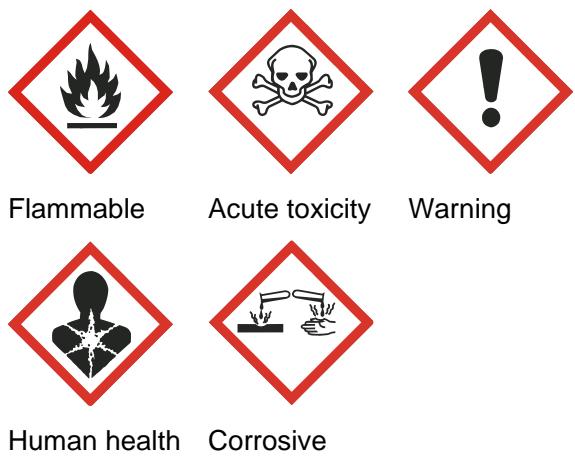 Figure 1 — GHS pictograms with signal words. Both "Danger" and "Warning" are recognised; "Danger" denotes the more severe hazard.
| Aspect | Register | Manifest |
|---|---|---|
| Scope | All hazardous chemicals | Schedule 11 only |
| Trigger | Mandatory always | Placard quantity exceeded |
| Purpose | PCBU & worker reference | Emergency services notification |
| Placard required | Only when placard qty exceeded | Yes |
Example placard / manifest thresholds (Schedule 11)
| Hazard class | Placard | Manifest |
|---|---|---|
| Flammable liquid Cat 1 | 50 L | 500 L |
| Acute toxicity Cat 1 | 50 kg | 500 kg |
| Oxidising liquid Cat 1 | 50 kg | 500 kg |
Once manifest quantity is exceeded: notify primary emergency services, provide site map + emergency plan, update on changes (Reg 352).
4. Storage & segregation
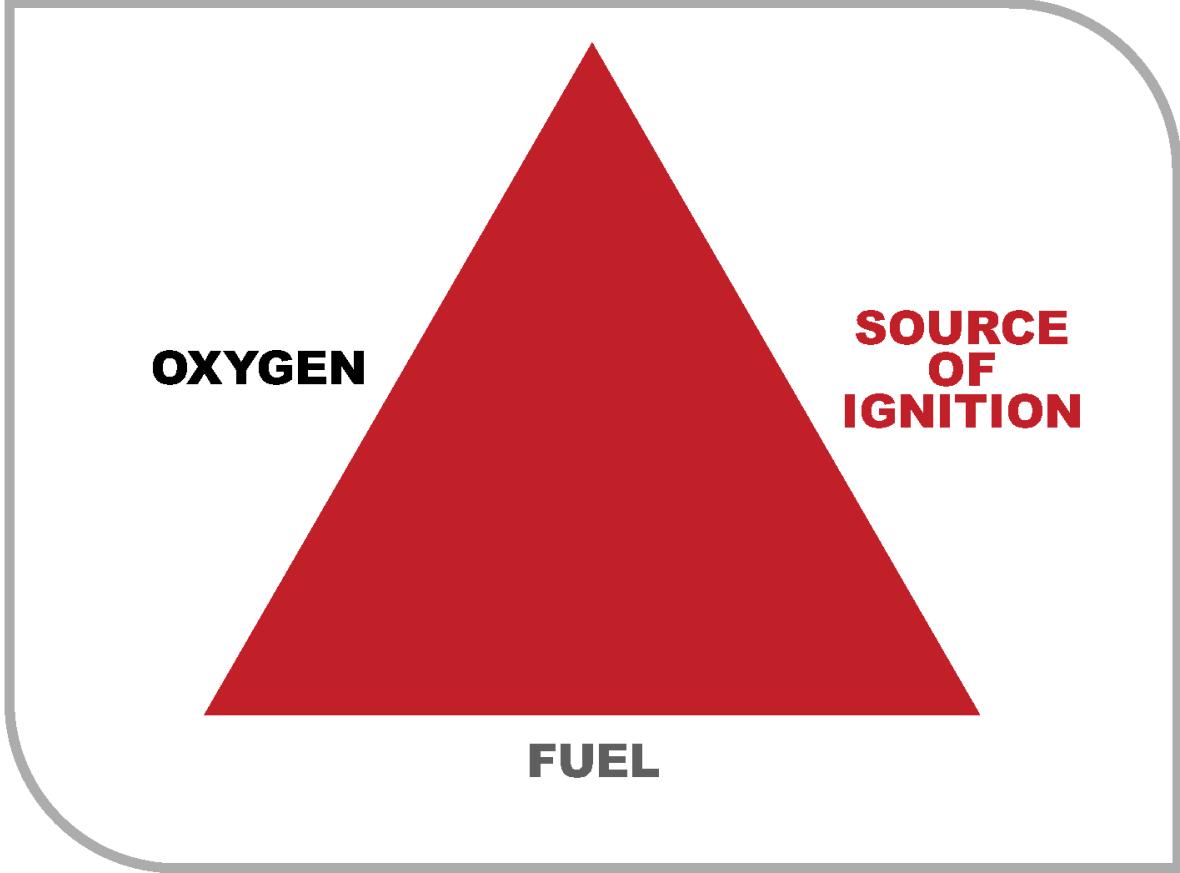 Figure 2 — Fire triangle. Removing fuel, oxygen, or ignition source breaks the triangle. Most chemical storage decisions trace back to this.
- Acids / bases — separate.
- Oxidisers — away from organics, solvents, flammables (per AS 4326).
- Flammable liquids — per AS 1940; vented cabinets; bunded.
- Compressed gases — upright, valve closed when unused, away from ignition, well ventilated, outdoor preferred.
- Containers stable, supported, fixed against dislodgement.
- Never store above incompatible material.
- Store dry unless SDS specifies moisture tolerance.
- Don't store where contamination of food / personal items / medication is possible.
5. Risk assessment (SDS-led)
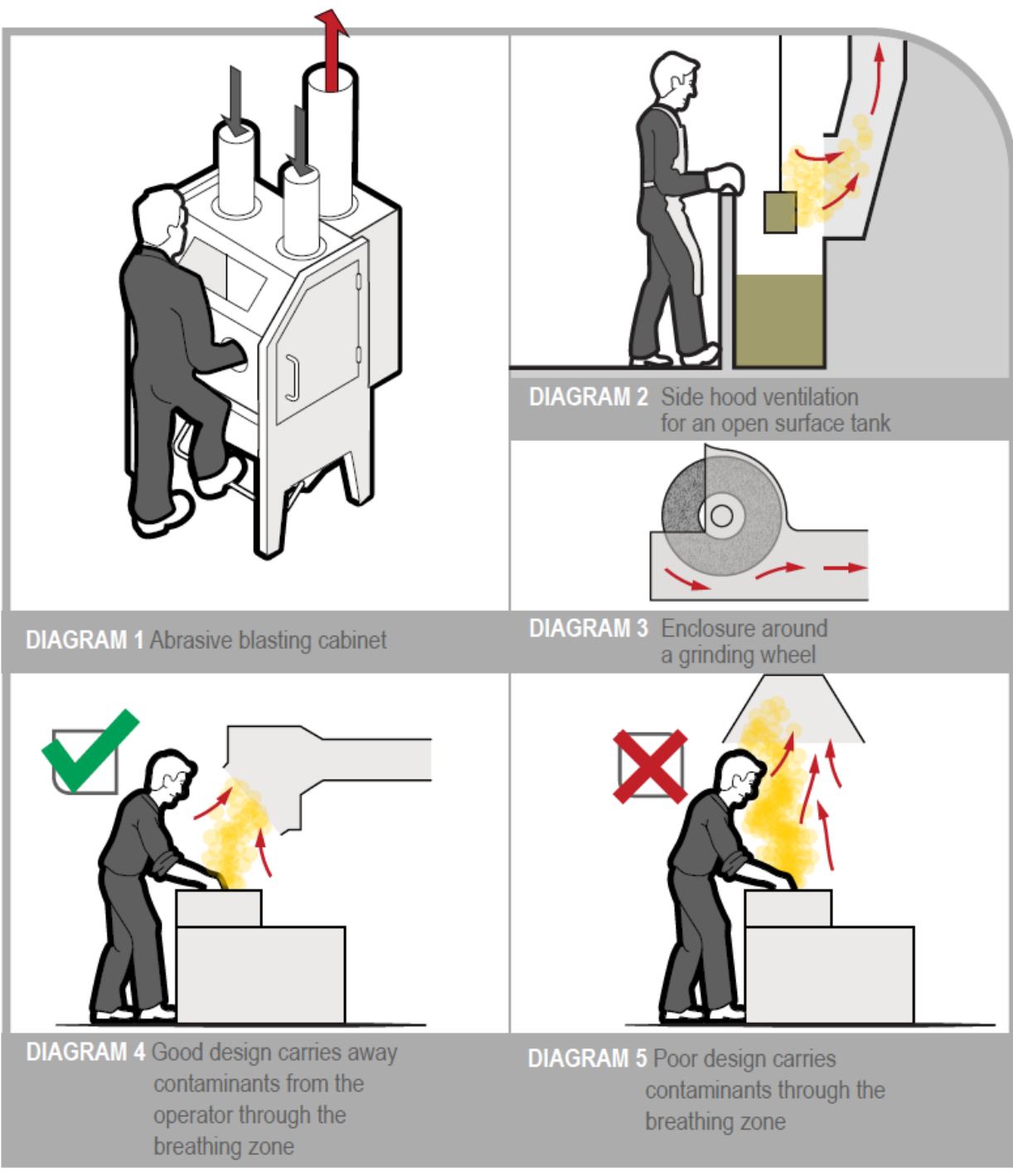 Figure 3 — Engineering controls: enclosed booth, side-hood, grinding enclosure. Capture at the source beats general dilution every time.
For each chemical, consider:
- Routes of entry — inhalation (primary for vapour/aerosol), skin / eye contact, ingestion.
- SDS sections 2, 7, 8, 9, 10 — hazard, handling, exposure controls, properties, reactivity.
- Exposure scenarios — frequency, duration, quantity, work process (spray, decant, heat, cut).
- Foreseeable failures — power out (ventilation), spill onto incompatible plant.
- Similarly Exposed Groups (SEGs) — if representable, assess group instead of every individual.
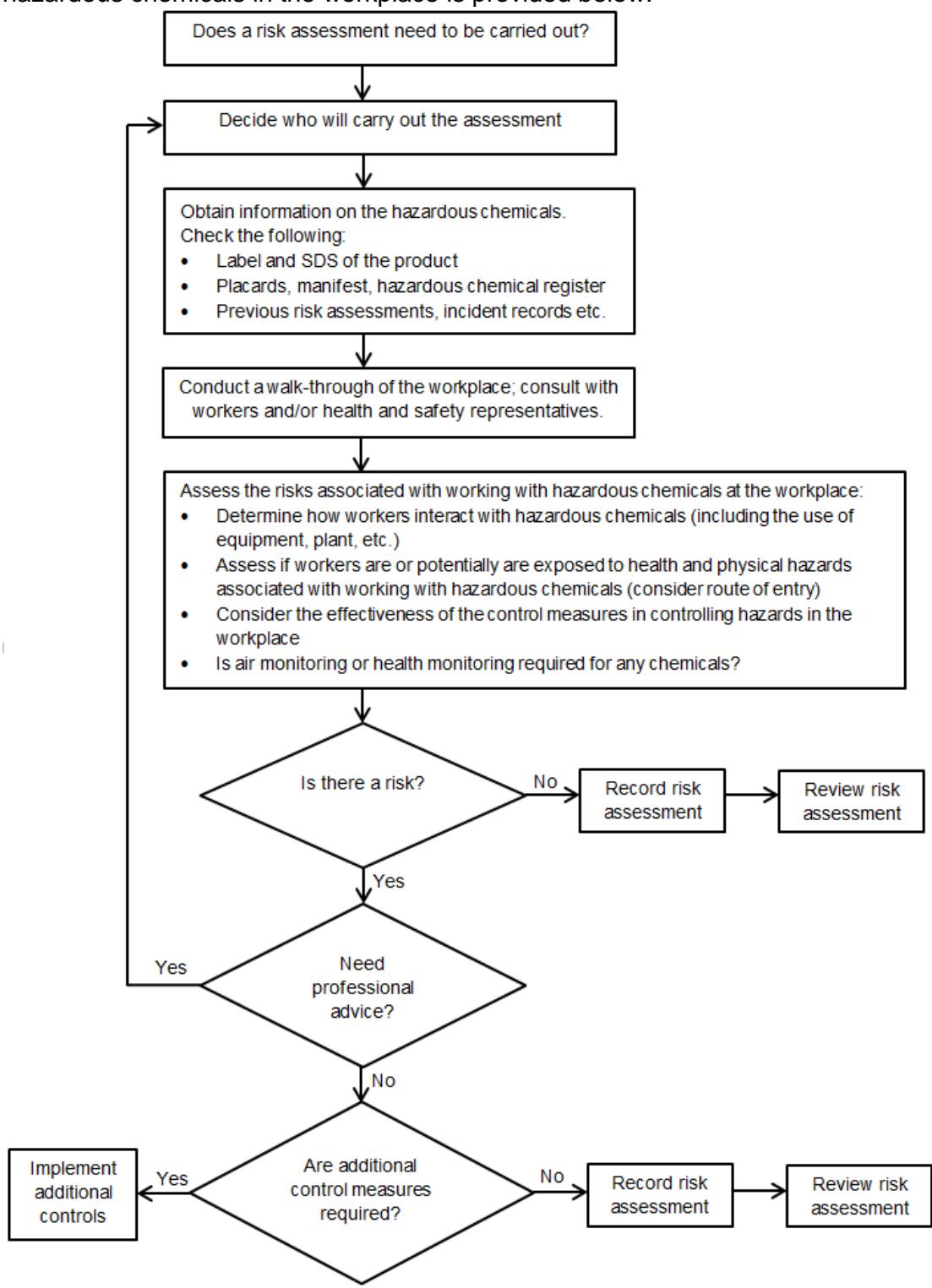 Figure 4 — Risk-assessment decision flow. Gather SDS + register + previous assessments → walk-through + consultation → assess routes / monitoring need → record outcome → review when triggers fire (new chemical, change of process, incident, HSR request).
6. Workplace Exposure Standards (WES) — Reg 49
| Standard | Definition |
|---|---|
| TWA (8-hour) | Time-weighted average over 8-h day, 5-d week. |
| STEL | Short-term exposure limit; 15-min TWA. |
| Peak | Maximum airborne concentration over the shortest practicable period (≤ 15 min). |
WES is absolute — must not be exceeded. The "reasonably practicable" qualifier doesn't apply.
Hazardous Chemical Information System (HCIS) — SWA database of WES values + guidance.
If results approach / exceed standard: review controls. For sensitisers (isocyanates), the "standard" is irrelevant — once sensitised, any re-exposure is a problem.
7. Atmospheric monitoring (Reg 50)
- Required for chemicals with a WES; baseline + periodic.
- Personal sampling (breathing zone) preferred over static.
- Trigger control review if > 50% of WES, or health monitoring indicates elevated exposure.
- Records 30 years retention.
8. Health monitoring (Reg 368)
Mandatory for ongoing significant exposure to Schedule 14 chemicals.
Schedule 14 includes:
- Acrylonitrile, benzene, isocyanates, lead, pentachlorophenol, RCS, asbestos, chromium VI, vinyl chloride, polycyclic aromatic hydrocarbons, cadmium, mercury, organotins.
Process:
- Registered medical practitioner with hazard-exposure experience; PCBU pays.
- Type per Schedule 14 (history, biological monitoring, lung function, X-ray as relevant).
- Worker informed pre-engagement.
- Confidential records ≥ 30 years (40 for asbestos).
- Adverse results → review controls + worker notification.
- Health monitoring does not replace controls; it verifies them.
9. Spill response & emergency plan
Spill containment (Reg 357)
- At point of use / handling / storage.
- Sized for the largest foreseeable spill without overflow.
- Compatible materials (no incompatible reactions).
- Bunding to prevent spread to groundwater / drains.
- Absorbents on hand; compatible types.
Emergency plan (Reg 351) — required if manifest quantity exceeded:
- Site map; chemical locations; alarm; evacuation routes.
- Isolation procedures; emergency-response team roles.
- Firefighting water retention (prevent environmental contamination).
- Hard copy on-site at all times; shared with emergency services.
- Tested / drilled regularly.
10. Records
| Record | Retention |
|---|---|
| Register + SDS | Current + updates |
| Air monitoring | 30 years |
| Health monitoring | 30 years (40 for asbestos) |
| Training | Employment + reasonable period |
| Incidents | Annual review; investigate trends |
| Emergency plan + drills | Current; per emergency-services feedback |
11. Common pitfalls / quick wins
Do
- Just-in-time ordering — reduce inventory & risk.
- Pre-mixed / diluted products where possible (eliminate worker mixing).
- Close containers immediately after use.
- Toolbox talks on SDS access and exposure routes.
- Annual control-effectiveness audit (inspection + monitoring trends).
- 2–3× annual emergency drills with local services.
Don't
- Rely on odour to detect a hazard (odour fatigue; not all chemicals smell).
- Use PPE as the primary control. It's the bottom of the hierarchy.
- Forget generated chemicals — welding fume, RCS, sewer gas.
- Leave decanted / waste containers unlabelled.
- Treat sensitisers like ordinary toxics — engineering control much more critical.
12. Cross-references
- Within §06: labelling_hazardous_chemicals, safety_data_sheets
- See also: managing_risks_of_plant, welding_processes, spray_painting_and_powder_coating (generated chemicals + isocyanates)
- §07: respirable_crystalline_silica, manage_and_control_asbestos
- Foundations: risk_management_process
- Glossary (PCBU, WES, SEG, manifest, placard): glossary_and_key_concepts
Source: managing_risks_of_hazardous_chemicals.md (Safe Work Australia, model Code of Practice, CC-BY-NC 4.0). Last verified against SWA: 2026-04-27.