Respirable Crystalline Silica (RCS)
Silicosis is irreversible. Australia banned engineered-stone benchtops in 2024. Treat any cutting, grinding, drilling, polishing of silica-containing material as HRCSW until proven otherwise.
- From 1 July 2024: manufacture, supply, processing and installation of engineered stone benchtops, panels and slabs is prohibited across all Australian states and territories.
- From 1 September 2024: amendments to model WHS Regulations introduced stronger regulation of work with all materials containing ≥ 1% crystalline silica, across all industries.
- November 2025 minor SWA updates to pages 40, 41, 61 (professional titles & reporting obligations).
- NSW version of this Code commenced 20 February 2026 — verify your jurisdiction's adoption date.
- WES: 0.05 mg/m³ 8-h TWA — absolute (Reg 49). Reduced from 0.1 mg/m³ in 2020.
- Engineered stone: prohibited new work. Legacy / removal / repair / disposal only, with notification.
- For HRCSW (high-risk crystalline silica work): SWMS + silica risk control plan + air monitoring + health monitoring.
- Wet methods + on-tool extraction + RPE is the practical control package on site.
- Health monitoring mandatory — chest X-ray + spirometry; low-dose HRCT recommended for high exposure.
1. What RCS is
- Crystalline silica = silicon dioxide (SiO₂): quartz, cristobalite, tridymite.
- Respirable fraction = particles ≤ 4 µm aerodynamic diameter — small enough to reach the deep lung.
- A solid silica-containing slab is benign; mechanical processing (cut, grind, drill, polish) generates the dust.
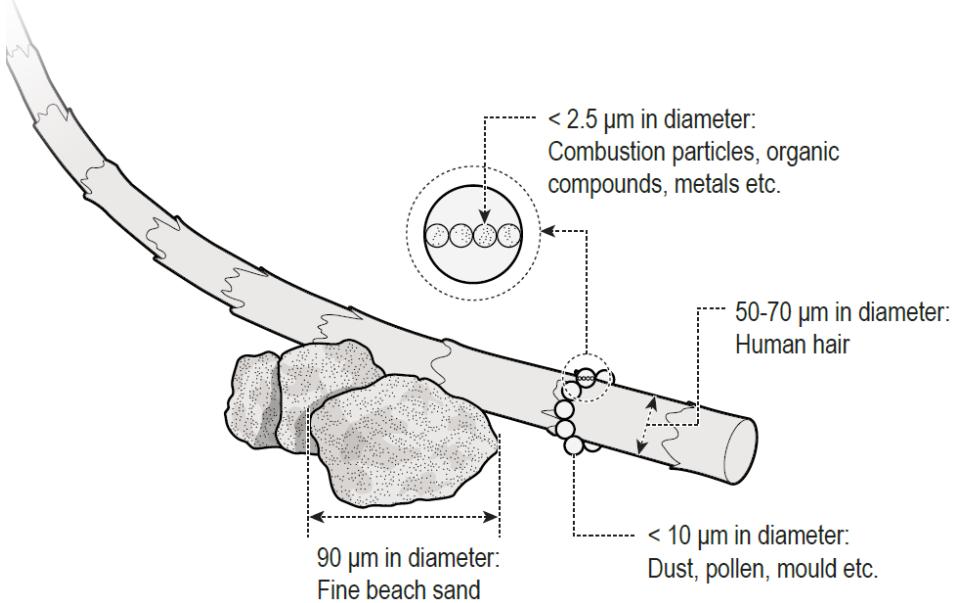 Figure 1 — Dust particle sizes. The respirable fraction (≤ 4 µm) reaches alveoli and never leaves.
2. WES (Reg 49)
| Standard | Value |
|---|---|
| 8-h TWA | 0.05 mg/m³ |
| Reduced from | 0.1 mg/m³ (pre-2020) |
| Duty | Absolute — must not be exceeded ("reasonably practicable" doesn't apply) |
Extended shifts (10 h+) require adjustment downward (8-h equivalent) by competent occupational hygienist.
3. Silica content in common materials
| Material | % crystalline silica |
|---|---|
| Engineered stone (legacy) | up to 80–97% |
| Sandstone (natural) | ≥ 90% |
| Granite (natural) | 20–45% |
| Concrete | 10–30% |
| Brick / mortar | 10–30% |
| Ceramic tile | 15–25% |
| Plasterboard | < 1% (typically) |
4. Engineered-stone ban — what's in / out
Prohibited (since 1 July 2024): manufacture, supply, processing, installation of engineered-stone benchtops, panels, slabs containing crystalline silica.
Permitted (with notification): removal, repair, minor modification, disposal of legacy in-place engineered stone. Must:
- Be notified to the regulator.
- Apply controlled wet cutting, on-tool extraction, or LEV.
- Maintain SWMS + silica risk control plan + RPE + monitoring.
Treat any encounter with engineered stone as legacy work. Confirm with the regulator's current notification process before starting.
5. High-risk crystalline silica work (HRCSW)
HRCSW = on-site cutting, grinding, drilling, sanding, polishing of silica-containing material that generates RCS dust. Falls under WHS HRCW (sense of "high-risk construction work" — SWMS required).
A Silica Risk Control Plan documents:
- % crystalline silica in product (verify with SDS).
- All dust sources and processes.
- Control measures for each task (with hierarchy applied).
- Air-monitoring results.
- Maintenance / inspection schedules for engineering controls.
- Incident / control-failure response.
- Worker training and PPE/RPE matrix.
6. Health hazards
- Silicosis — acute (weeks–months severe exposure), accelerated (1–10 yrs), chronic (>10 yrs lower exposure). No cure.
- Lung cancer (Group 1 carcinogen).
- COPD, chronic bronchitis.
- Autoimmune disorders: scleroderma, SLE, rheumatoid arthritis.
- Chronic kidney disease.
- Latent TB activation, eye damage.
All preventable through controls + monitoring.
7. Hierarchy applied to RCS
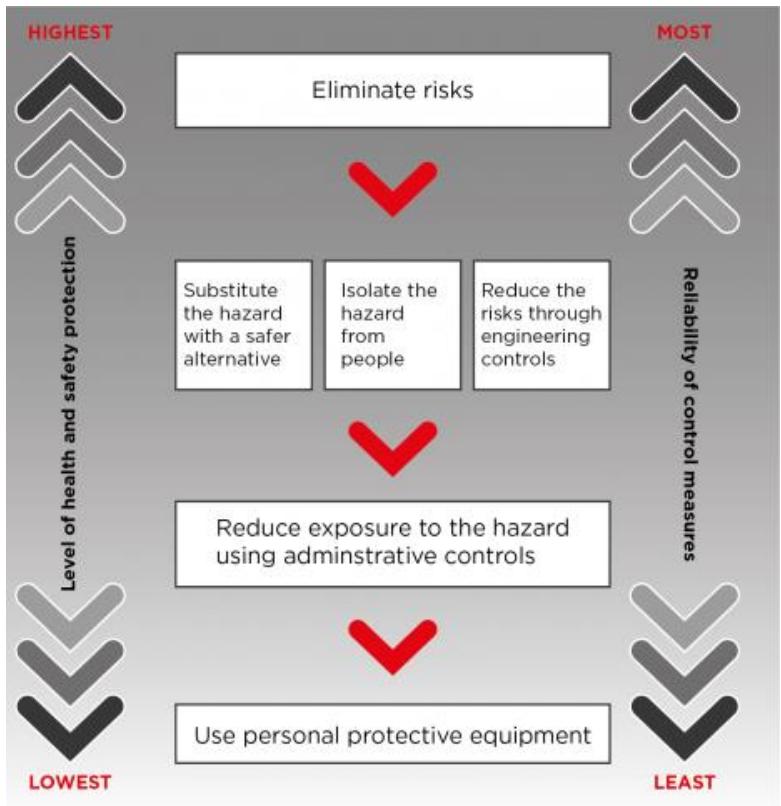 Figure 2 — Hierarchy of controls applied to RCS. Always work down. Don't start at PPE.
1. Eliminate
- Avoid silica-containing materials (substitute non-silica benchtops, lower-silica abrasives).
- Move all cutting off site to a fabrication facility (eliminate on-site dust).
- Pre-fabricate sized slabs with sink holes pre-cut.
2. Substitute
- Lower-silica abrasive (garnet ≤ 1% vs silica sand ≥ 95%).
- Different process (saw → laser → off-site CNC).
3. Engineering
- Wet cutting with continuous water supply (≥ 0.5 L/min directional spray, splash guards).
- On-tool LEV extraction + HEPA filter (most practical for handheld site tools).
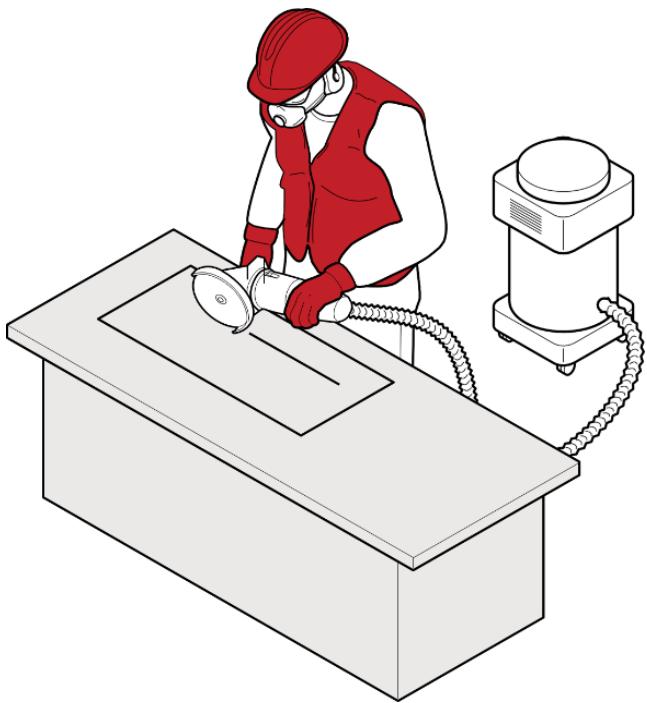 Figure 3 — On-tool dust extraction with HEPA-filtered vacuum. The shroud sits at the cut; the hose carries dust to the vacuum. The standard on-site control.
 - Fixed LEV for stationary tools — hood + duct + fan + outdoor exhaust.
- Enclosed cabin with HEPA-filtered air for high-volume cutting.
4. Administrative
- Off-site cutting (back to step 1 in mindset).
- Minimum cuts per job; pre-template at fabrication.
- Rotation to limit daily exposure.
- No dry sweeping, no compressed air, no high-pressure hosing — these resuspend settled dust.
- HEPA vacuum + wet wipe only.
- Exclusion zones; rest areas away from dust.
- Inspection / maintenance schedules for LEV, HEPA filters, water systems.
5. PPE / RPE
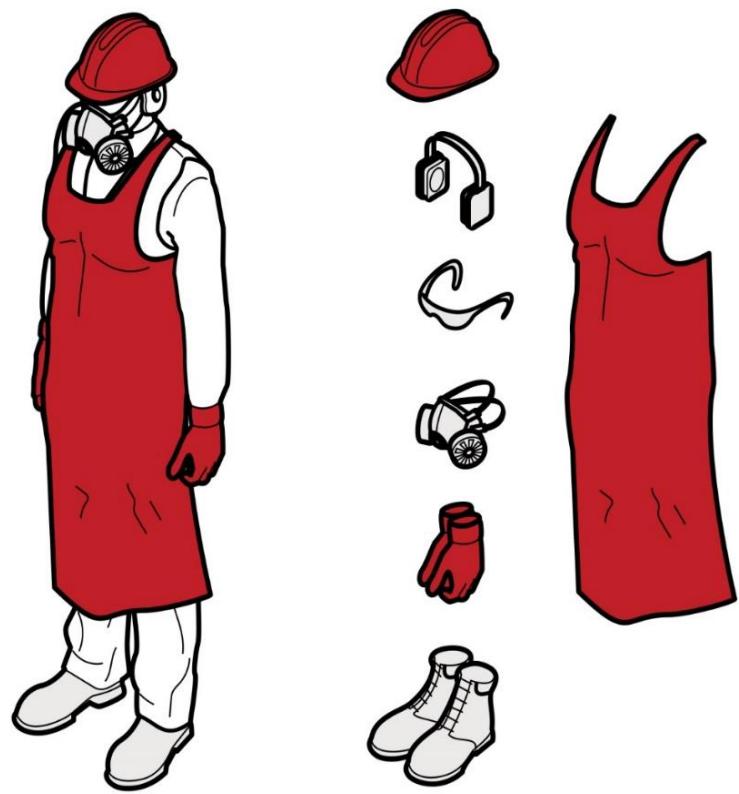 Figure 4 — RPE options: half-face P2 (general), full-face P3 (high exposure), PAPR (preferred for prolonged work). Tight-fitting RPE requires annual quantitative fit-test and clean-shaven seal.
- Minimum: half-face P2 (handheld tools with wet + LEV controls).
- High-exposure: full-face P3 negative-pressure or PAPR.
- PAPR hoods: no fit-test required (loose fit); recommended for prolonged grinding / polishing.
8. Health monitoring (Reg 368, Schedule 14)
Mandatory for ongoing significant exposure to RCS.
| Test | Frequency |
|---|---|
| Baseline (pre-engagement) | Within 2 yrs prior or before commencement |
| Periodic | At least annually for high-risk work |
| Final on exit | At cessation of exposure |
| Components | History + standardised respiratory questionnaire + spirometry (FEV₁ / FVC / ratio) + chest X-ray (PA, B-reader) |
| Recommended for high exposure | Low-dose HRCT (more sensitive than X-ray for early silicosis) |
PCBU pays all fees and worker release time. Records confidential, 30-year retention minimum. Adverse results trigger control review.
9. Atmospheric monitoring
- Personal sampler in worker's breathing zone, full shift (incl. breaks).
- Analysed by competent occupational hygienist.
- Baseline + at least every 12 months; on triggers (process change, adverse health result, HSR request, WES change).
- Records 30 years; accessible to workers.
10. Construction examples + practical controls
| Task | Hazard | Controls |
|---|---|---|
| Tile cutting (wet saw) | Visible dust + slurry | Continuous water + on-tool LEV + P2 |
| Concrete cutting / grinding (handheld) | Mod-high dust | Wet cutting + on-tool LEV + P2/P3 RPE |
| Sink-hole drilling into legacy benchtop | Mobile high-exposure | Water suppression + extraction shroud + full-face P3 |
| Dry grinding for fit | Severe | Eliminate — pre-fabricate, no on-site dry grinding; or wet + extraction |
| Post-install polishing | Fine abrasive dust | Water + polisher shroud + on-tool extraction + PAPR |
| Excavation / rock drilling | Concrete + rock dust | On-tool / cabin LEV + RPE; cabin filtration with HEPA |
11. Records & training
- Air monitoring reports — 30 yrs.
- Health monitoring reports — confidential, 30 yrs.
- SWMS for HRCSW.
- Silica Risk Control Plan.
- Fit-test records per worker (quantitative, annual).
- Maintenance logs — LEV, filters, water systems.
- Training: hazards, controls, RPE use/maintenance, health monitoring purpose.
12. Common pitfalls / quick wins
Do
- Treat any encounter with engineered stone as prohibited new work — confirm legacy / removal status with the regulator.
- Pre-fabricate to eliminate on-site cutting.
- Wet cutting + on-tool extraction is the practical site combo — never one without the other.
- HEPA H-class vacuum + wet wipe only; banish brooms and compressed air.
- Annual quantitative fit-test for tight-fitting RPE; clean-shaven seal.
- Schedule chest X-ray + spirometry annually; consider HRCT for high-exposure roles.
- Map silica risk into your hazardous chemicals register so the WES / health-monitoring trigger is visible.
Don't
- Rely on general ventilation alone.
- Accept "low silica" claims without an SDS confirmation.
- Treat dry sweeping as cleaning — it's resuspension.
- Skip baseline health monitoring "because the worker looks healthy" — silicosis is silent for years.
- Continue manufacture / supply / installation of engineered-stone benchtops. Banned.
13. Cross-references
- See also: abrasive_blasting (silica banned as media), demolition_work (concrete dust), excavation_work (rock cutting), managing_noise_and_preventing_hearing_loss (combined dust + noise on the same task)
- Within §07: manage_and_control_asbestos, safely_remove_asbestos
- Foundations: risk_management_process
- Glossary (RCS, WES, HRCSW, PAPR, HEPA, HRCT): glossary_and_key_concepts
Source: managing_risks_of_respirable_crystalline_silica.md (Safe Work Australia, model Code of Practice — engineered-stone focus). ISBN 978-1-76114-105-6 (PDF). Last verified against SWA: 2026-04-27. NSW jurisdictional commencement: 20 February 2026. Minor updates November 2025.