Manage and Control Asbestos
Anything built before 31 December 2003 is presumed to contain asbestos until proven otherwise. The default control is to leave undisturbed and manage, not remove.
- Until 30 November 2026: comply with the existing WES for respirable asbestos (0.1 fibres/mL 8-hour TWA, clearance air-monitoring action level 0.01 f/mL).
- From 1 December 2026: SWA classifies asbestos as one of the 33 Non-Threshold Genotoxic Carcinogens (NTGCs). There will be no numerical exposure limit — asbestos is treated as having no safe exposure threshold. The PCBU duty becomes eliminate or replace (then engineering / admin / RPE in the standard hierarchy). The 0.01 f/mL clearance threshold in this Code's air-monitoring procedures remains unchanged because it derives from the Code itself, not from the WES list.
- Watch for SWA guidance on regulating NTGCs under the model WHS laws (in development through the transition).
- Pre-31 Dec 2003 buildings must be presumed to contain ACM until a competent person confirms otherwise.
- Asbestos register (Reg 425) + Asbestos management plan (Reg 429) are the two mandatory documents.
- Hierarchy: leave undisturbed → encapsulate → enclose → remove (last resort).
- Friable vs non-friable drives risk and the licence type required for any future removal.
- Records: register kept until ACM gone + clearance issued; health monitoring 40 yrs.
1. The six asbestos minerals (all Group 1 carcinogens)
| Common name | Mineral | Group |
|---|---|---|
| White | Chrysotile | Serpentine |
| Brown | Amosite (grunerite) | Amphibole |
| Blue | Crocidolite | Amphibole |
| — | Tremolite | Amphibole |
| — | Actinolite | Amphibole |
| — | Anthophyllite | Amphibole |
Health hazards: mesothelioma, lung cancer, asbestosis, pleural disease.
Exposure standard (current, until 30 Nov 2026): respirable asbestos 0.1 fibres/mL 8-h TWA (WES list). Clearance air-monitoring action level: 0.01 fibres/mL (set by this Code, retained post-transition). From 1 Dec 2026 asbestos becomes one of the 33 NTGCs with no numerical limit — duty shifts to elimination / replacement (see Transition note above).
2. Friable vs non-friable
| Type | Definition | Risk | Examples |
|---|---|---|---|
| Friable | Powder, or can be crumbled / pulverised by hand pressure when dry. | High — fibres release easily. | Sprayed insulation, lagging, gaskets in poor condition, asbestos cement that has weathered to powder. |
| Non-friable | Bonded into a matrix; intact. | Low while in good condition; rises with damage / abrasion. | Fibre-cement sheets, vinyl floor tile, pipe insulation in good condition, switchboard, gaskets. |
3. Pre-31 Dec 2003 presumption (Reg 422)
Any building, plant or fixture installed / constructed before 31 December 2003 must be assumed to contain asbestos until proven otherwise by a competent person.
| Era | Likelihood |
|---|---|
| Pre-1990 | High likelihood of ACM |
| 1990–2003 | Possible — refurbishments, imported equipment, stockpiled stock |
| Post-2003 | No presumption (if wholly metal / brick / concrete with no cladding or interior fittings) |
4. Asbestos register (Reg 425)
Mandatory for any workplace built before 31 Dec 2003 (unless ACM proven absent), or where ACM is identified or assumed present.
Each entry records:
- Date identified / assumed.
- Material type (fibre cement, lagging, vinyl tile, gasket, switchboard, etc.).
- Friable / non-friable.
- Condition: good / fair / poor / damaged / deteriorating.
- Specific location.
- Accessibility (accessible vs sealed in cavity / underground).
Retain the register until all ACM is removed AND clearance certificate is obtained.
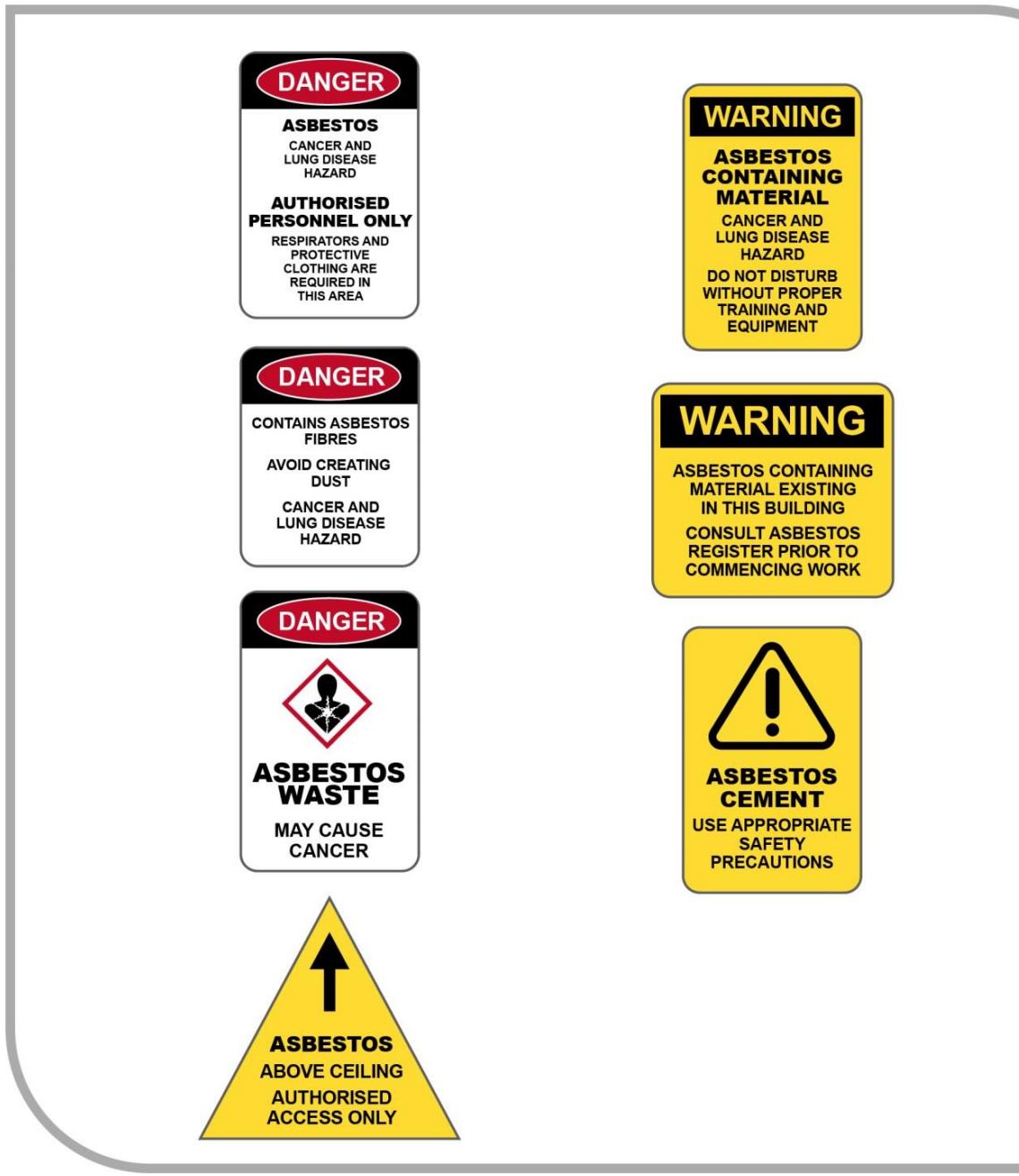 Figure 1 — Asbestos warning signs. Posted at entrances and on labelled in-place ACM. Standard-compliant signage is part of the management plan.
5. Asbestos management plan (Reg 429)
Required wherever the register identifies ACM (or whenever ACM is likely to be present).
Includes:
- Reference to the register; label / sign locations.
- Decisions and reasons for control measures (encapsulate / enclose / remove / leave undisturbed).
- Accident / incident / emergency procedures.
- Consultation, training, responsibility matrix.
- Control-measure outline; hierarchy applied.
- Timetable for reviews, removals, planned disturbance.
- Air-monitoring procedures (where required).
Review: at least every 5 years, or whenever ACM is removed / disturbed / sealed / enclosed; the register is revised; an HSR requests review.
6. Identification by competent person (Reg 5)
Competent person:
- Trained in asbestos sampling and handling.
- Knowledge to identify suspected ACM and assess condition / friability.
- May be qualified occupational hygienist, Licensed Asbestos Assessor (LAA), removal supervisor, or NATA-accredited.
Methods: visual inspection + bulk material sampling + NATA-accredited laboratory analysis (AS 4964 standard).
7. Labelling and signage (Reg 424)
In-place ACM must be clearly labelled:
- Asbestos warning symbol + text.
- Location and material type.
- Date of identification / labelling.
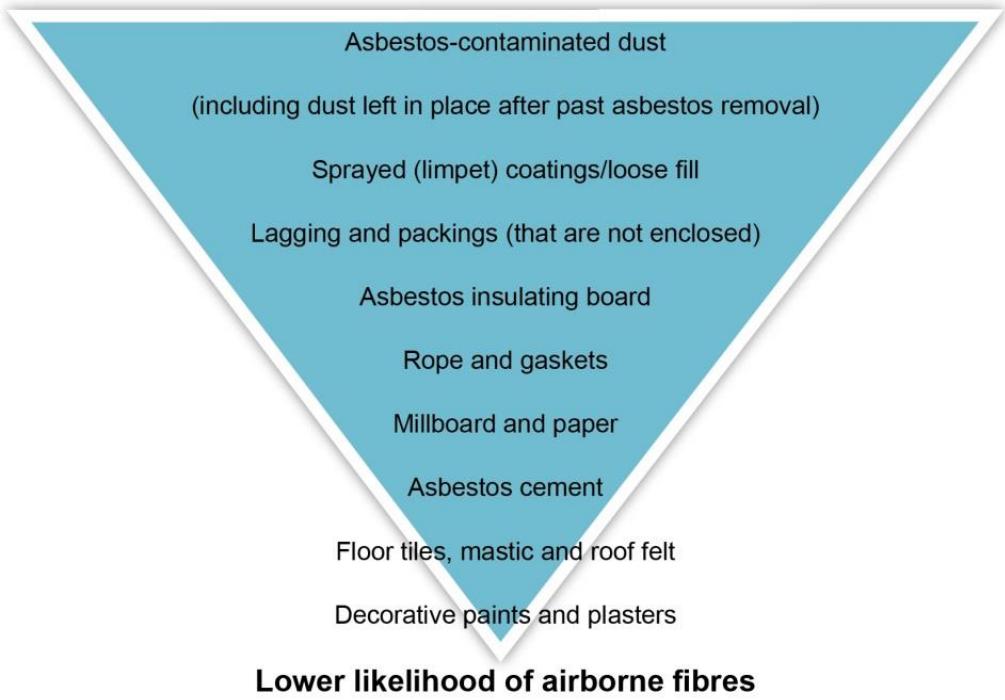 Figure 2 — Asbestos labelling at the building scale. Signs at entrances direct workers to the register and management plan.
Where direct labelling isn't practicable (vinyl tile under furniture, pipes in cavities), post warning signs at entry points referring workers to the register / on-site plan.
8. Risk assessment (Reg 420)
Assess:
- Condition — good, sound, deteriorating, cracked, crumbling, broken.
- Location — accessible vs inaccessible.
- Likelihood of disturbance — proximity to routine work, maintenance, demolition, refurbishment, forklift impact, acid fumes, weather exposure.
Examples of disturbance risk:
- Forklift striking AC walls.
- Plumbers near asbestos-insulated pipes.
- Electricians wiring in friable sprayed-asbestos ceiling spaces.
- Acid fumes eroding AC roof / walls.
9. Control measures hierarchy (Part 8.3)
Removal is not the default. Most ACM is safest left in place under management.
| Order | Control | When |
|---|---|---|
| 1 | Leave undisturbed | Stable, non-friable, good condition, low disturbance risk. |
| 2 | Encapsulate | Seal surface with coating (epoxy, sealant) to bind loose fibres. Interim solution; trained personnel + PPE. Not for friable or damaged. |
| 3 | Enclose | Build a physical barrier (false wall, duct enclosure) around ACM. Non-friable only; full isolation from work activities. |
| 4 | Remove | When condition / disturbance dictates. Requires licensed removalist + clearance inspection. See safely_remove_asbestos. |
Admin (procedures, training) and PPE are layered on; they do not replace higher-order controls.
10. Periodic review & register updates
Update the register and review the management plan when:
- Management plan is reviewed (5-yearly minimum).
- Further ACM is discovered.
- ACM is removed, disturbed, sealed, enclosed.
- Demolition / refurbishment is planned.
- Condition has changed (visual inspection schedule).
11. Air monitoring (Reg 420)
Required when:
- Asbestos-related work is undertaken and exposure standard may be exceeded.
- Disturbance risk is uncertain.
- High-speed or abrasive tools are used on ACM.
Notification trigger: air monitoring exceeding 0.01 fibres/mL must be reported to the regulator. This 0.01 f/mL clearance threshold derives from the Code itself and is unaffected by the 1 Dec 2026 WEL transition.
12. Health monitoring (Reg 440, Schedule 14)
Applies to:
- Workers performing licensed asbestos removal work — pre / during / post (see safely_remove_asbestos).
- Workers at risk of exposure during asbestos-related work.
Conducted by registered medical practitioner: demographic / occupational history; respiratory function tests; chest examination.
Records: 40-year retention (per Schedule 14 — longest in the WHS framework).
13. Records & training
| Record | Retention |
|---|---|
| Asbestos register | Until all ACM removed + clearance |
| Management plan | Current; 5-year review cycle |
| Air monitoring | 30 years |
| Health monitoring | 40 years (confidential) |
| Training records | Worker employment + 5 years post |
| Removal records (when applicable) | See safely_remove_asbestos |
Training covers:
- Health risks of asbestos types, likely presence, use in workplace.
- PCBU and worker roles under the management plan.
- Register location and interpretation.
- Safe work procedures and exposure controls.
- PPE / RPE use.
- Exposure / health monitoring purpose.
14. Common pitfalls / quick wins
Do
- Presume asbestos in pre-2003 buildings. Confirm absent only by competent person + lab analysis.
- Leave stable non-friable ACM undisturbed — that's safest and cheapest.
- Encapsulate deteriorating non-friable surfaces with epoxy paint as an interim control.
- Mark inaccessible areas clearly in the register so maintenance crews don't disturb them by accident.
- Annual visual inspection; photograph sealed surfaces to track condition.
- Make sure HSRs and trades have access to the current register before any disturbance work.
Don't
- Use household vacuum cleaners on suspected ACM. Use HEPA H-class industrial only.
- Dry sand / grind / pressure-wash ACM. Banned — releases friable fibres.
- Leave the register stale after a removal or refurb — update immediately.
- Assume "looks fine" = "is fine". Sample if uncertain.
- Skip the management plan because the building "is going to be demolished anyway" — both register and plan must be current right up to demolition.
15. Cross-references
- Within §07: safely_remove_asbestos, respirable_crystalline_silica
- Renovation / demolition triggers: demolition_work, general_construction_work (Reg 291 HRCW: any work likely to disturb asbestos)
- Hazardous chemicals: managing_risks_of_hazardous_chemicals (Schedule 14)
- Foundations: risk_management_process
- Glossary (ACM, friable, LAA, NATA): glossary_and_key_concepts
Source: manage_and_control_asbestos.md (Safe Work Australia, model Code of Practice, CC-BY-NC 4.0). Edition: July 2020. WES → WEL transition 1 Dec 2026: asbestos reclassified as a Non-Threshold Genotoxic Carcinogen (NTGC); no numerical limit post-transition — eliminate / replace duty applies. WES (0.1 f/mL 8-h TWA) remains in force until 30 Nov 2026. Last verified against SWA: 2026-04-28.