Falls in Housing Construction
Detached, terrace, townhouse, garage, gazebo. The hazards are different from generic falls because workers interact with incomplete structures lacking permanent edge protection. Specific code, specific controls.
- Applies to NCC Class 1a / 1b / 10 buildings (houses, townhouses, ancillary). Maintenance/renovation is out of scope.
- Falls > 2 m = HRCW; SWMS required.
- Solid construction → passive prevention → work positioning → fall arrest → admin → ladders. Always in that order.
- Roof pitch: ≤ 26° with edge protection; > 26° add infill or catch platform; > 35° don't stand on it.
- Ladders only for low-risk, short-duration, single-handed work. 4:1 rule for setup.
1. Scope
- In scope: NCC Class 1a (detached houses), 1b (townhouses, terrace, boarding houses < 300 m²), Class 10 (garages, gazebos, carports). Up to 2 storeys.
- Out of scope: maintenance / renovation of existing housing, multi-storey > 2 storeys, dismantling/demolition (use demolition_work / managing_risk_of_falls).
- Why a separate code: housing-specific phases (truss erection on partial wall plates, prefab sequencing, scaffold-on-slab, fascia/eaves work) involve workers on incomplete structures.
2. Typical fall scenarios
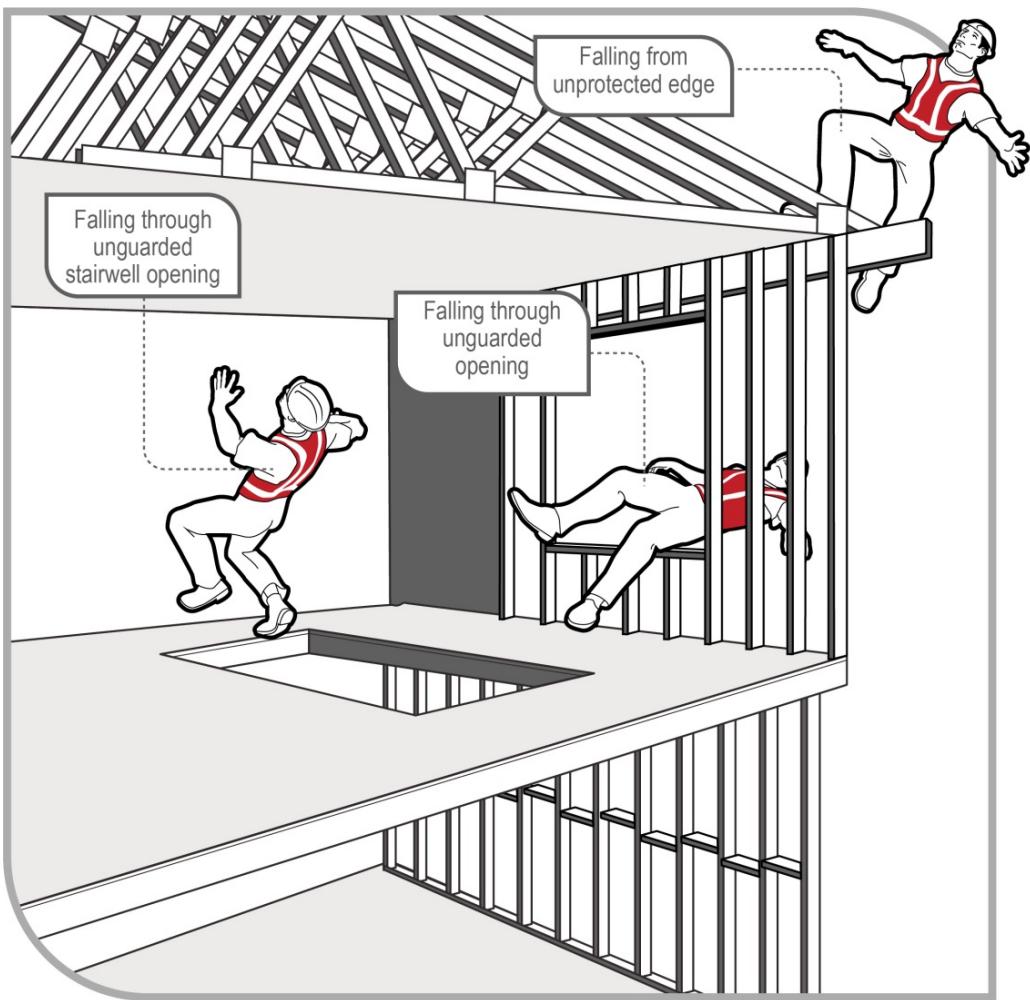 Figure 1 — Common fall scenarios in housing construction. Workers at upper-floor open edges, on truss top plates, off gable ends, through stairwells, off ladders.
3. Stages and their fall risks
| Stage | Risk |
|---|---|
| Footings / slab | Falls into trenches, voids — covered by excavation_work. |
| Floor laying (upper) | Open edges, voids; install edge protection before laying. |
| Wall frame erection | Workers on joist/plate level with no rails; risk of falls outward and into stairwells. |
| Roof truss erection | Critical phase; workers stand on internal top plates; falls through unbraced trusses; falls off gable. SWMS mandatory. |
| Roof batten fixing | Falls between trusses if spacing > 600 mm. Bottom chord becomes walking surface only when braced ≤ 3 m. |
| Roof covering (tiles/metal) | Pitched surface, fragile materials, gable edges. |
| Eaves, fascia, gutters | 2–4 m external work; trestle scaffold / EWP / external platform. |
| Scaffold-on-slab | Internal platform for finishes; inspect, tag, assemble per spec. |
4. The 2 m rule
WHS Reg 78: any work where a worker could fall more than 2 m triggers HRCW + SWMS. In housing construction this captures:
- Upper-floor activity, roof work, wall plates ≥ 2 m above ground.
- Scaffolds from slab to upper level (typically > 2 m).
- Exception: ground / 1st-floor ladder work below 2 m doesn't strictly need SWMS but still requires the hierarchy to be applied.
Reg 225: scaffold from which a fall > 4 m is possible — written competent-person inspection required before erection, and after every alteration / weather event.
5. Hierarchy applied to falls
Always work down. Ladders are last, not first.
- Eliminate WAH — prefab at ground (truss assembly, frame assembly, panel cladding).
- Solid construction / passive prevention — perimeter scaffold with rails; floor laid early; barriers around voids.
- Work positioning (restraint) — harness + short lanyard preventing reach to the edge.
- Fall arrest — harness, lanyard with shock absorber, anchor; with rescue plan.
- Administrative — sequencing, no-go zones, supervision, permits.
6. Edge protection
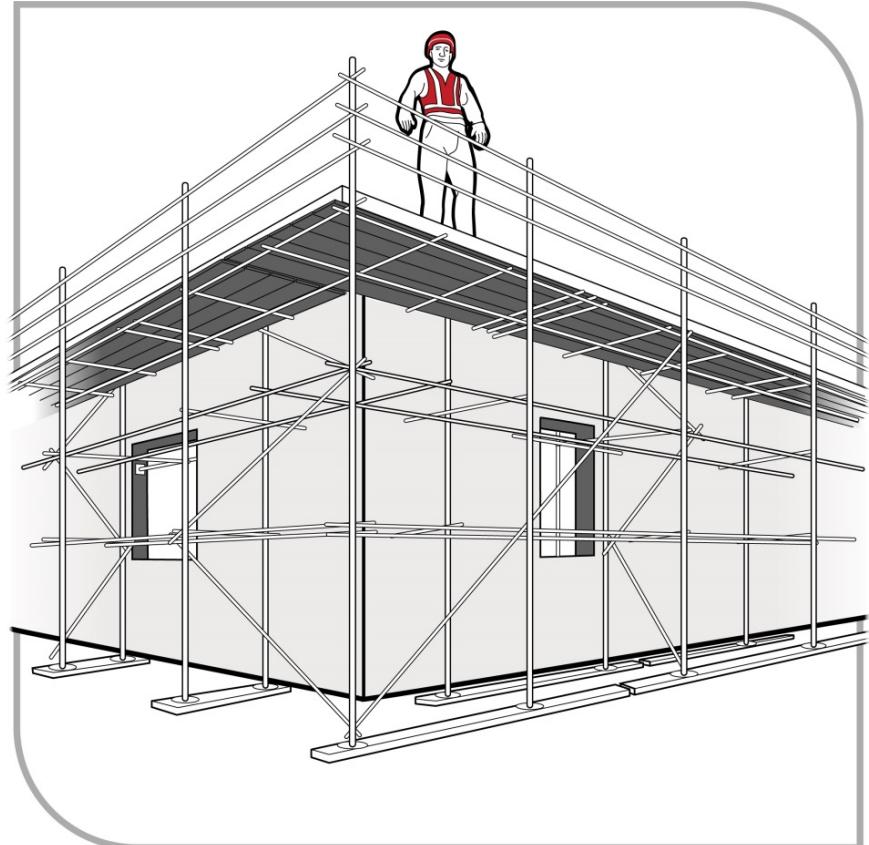 Figure 2 — Perimeter scaffold for housing: full-deck working platform, top rail, mid-rail, toeboard.
Specs
- Top rail 900–1100 mm above working surface.
- Mid-rail or infill mesh — gaps ≤ 275 mm.
- Toeboard ≥ 150 mm.
- For roofs > 10°: effective height measured 300 mm in from edge.
- Roofs > 26°: infill panels / mesh required + catch platform ≤ 500 mm below edge.
Designed for impact — posts must bend about their strong axis.
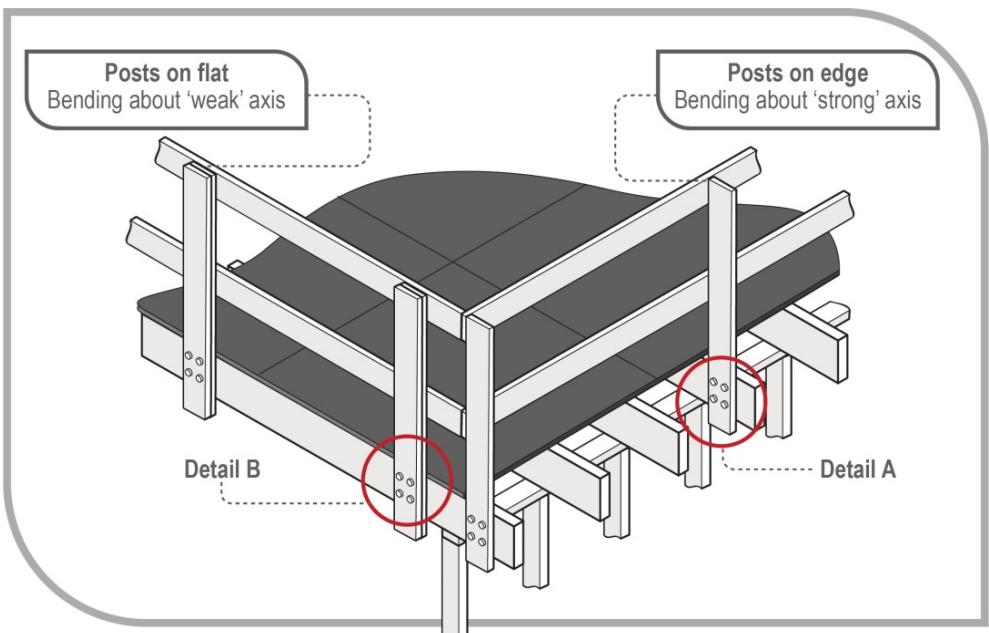 Figure 3 — Timber guardrail post: bending about the strong axis (right) resists impact; weak-axis orientation (left) fails. Bolt + fishplate connections required.
Window/door openings in raised wall frames — protect before the frame goes up.
7. Ladders — narrow role only
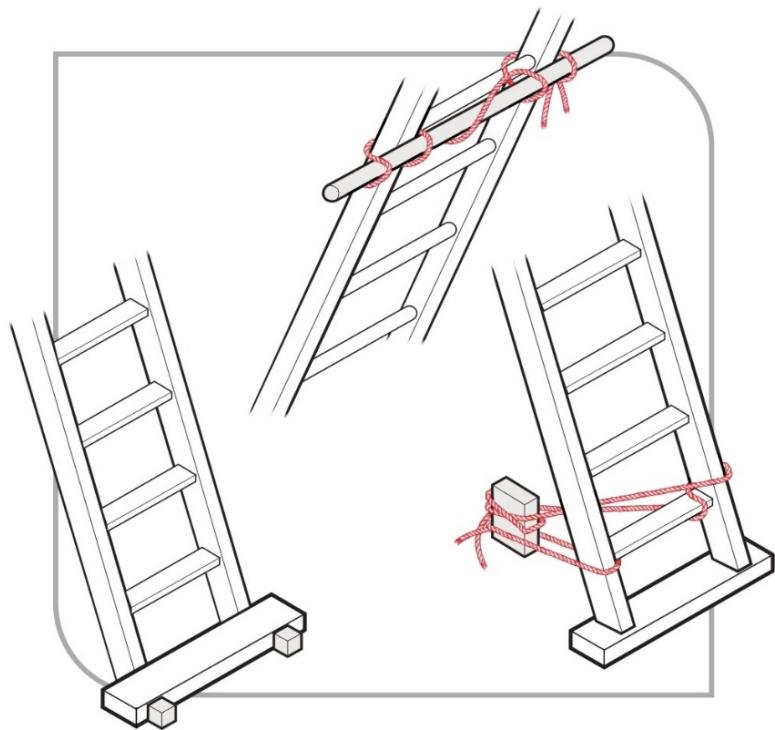 Figure 4 — Securing a ladder. 4:1 rule: base out 1 unit for every 4 units of height. Tie at top. Extends ≥ 1 m above stepping-off point. Non-slip feet.
Allowed for:
- Access / exit only.
- Short-duration, light, single-handed work (gutter clean, painting downpipes, minor electrical).
Not allowed:
- Tasks needing two hands (power tools, holding two-handed loads).
- Working from a ladder near unguarded edges/openings without additional PPE.
- Straddling, overreaching, work above shoulder.
Setup:
- Three points of contact at all times; 2 feet + 1 hand climbing; thigh on rung when working.
- Tool belt, not hand-carried tools.
- Single person.
- Slip-resistant footwear.
- No higher than: 900 mm below top (single/extension); 2nd tread from top (stepladder).
Prefer: EWPs, scissor lifts, mobile scaffolds, trestle scaffolds.
8. Mobile scaffolds and trestles
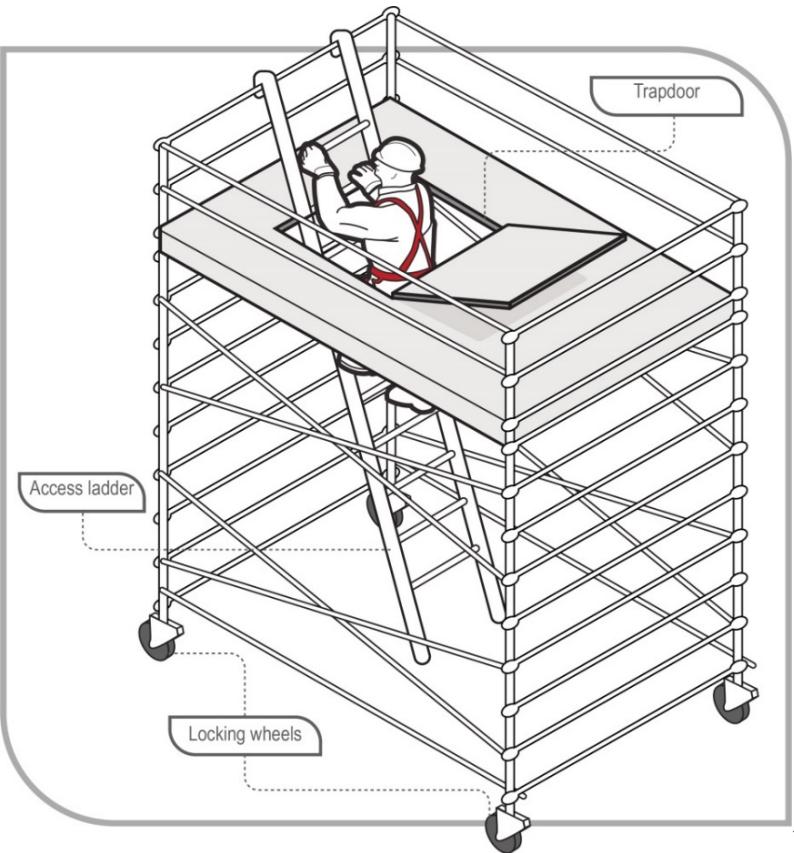 Figure 5 — Mobile scaffold with internal access ladder. Castors locked before entry; never moved while occupied.
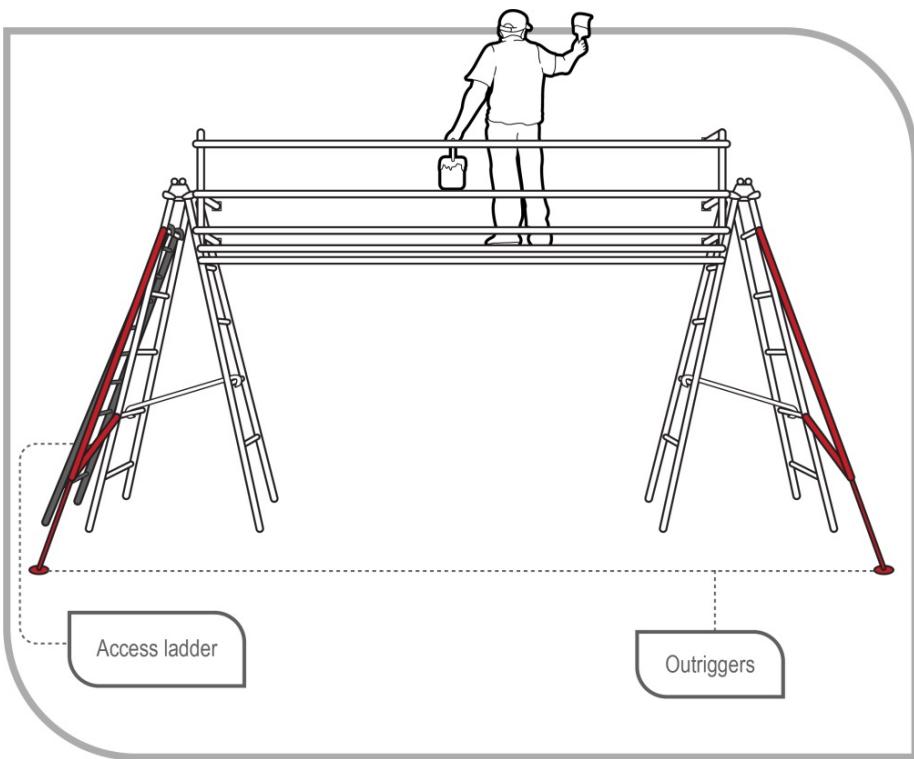 Figure 6 — Trestle ladder scaffold with guardrailing and outriggers — light-duty external work only.
Trestle rules:
- Light/medium-duty only (paint, render, fascia).
- ≤ 2 m without guardrail; > 2 m needs top + mid + toeboard.
- Internal use only — not for external edges.
Mobile scaffolds:
- Castors locked before entry; never moved while occupied.
- Internal ladder access; tag inspections.
9. Roof work
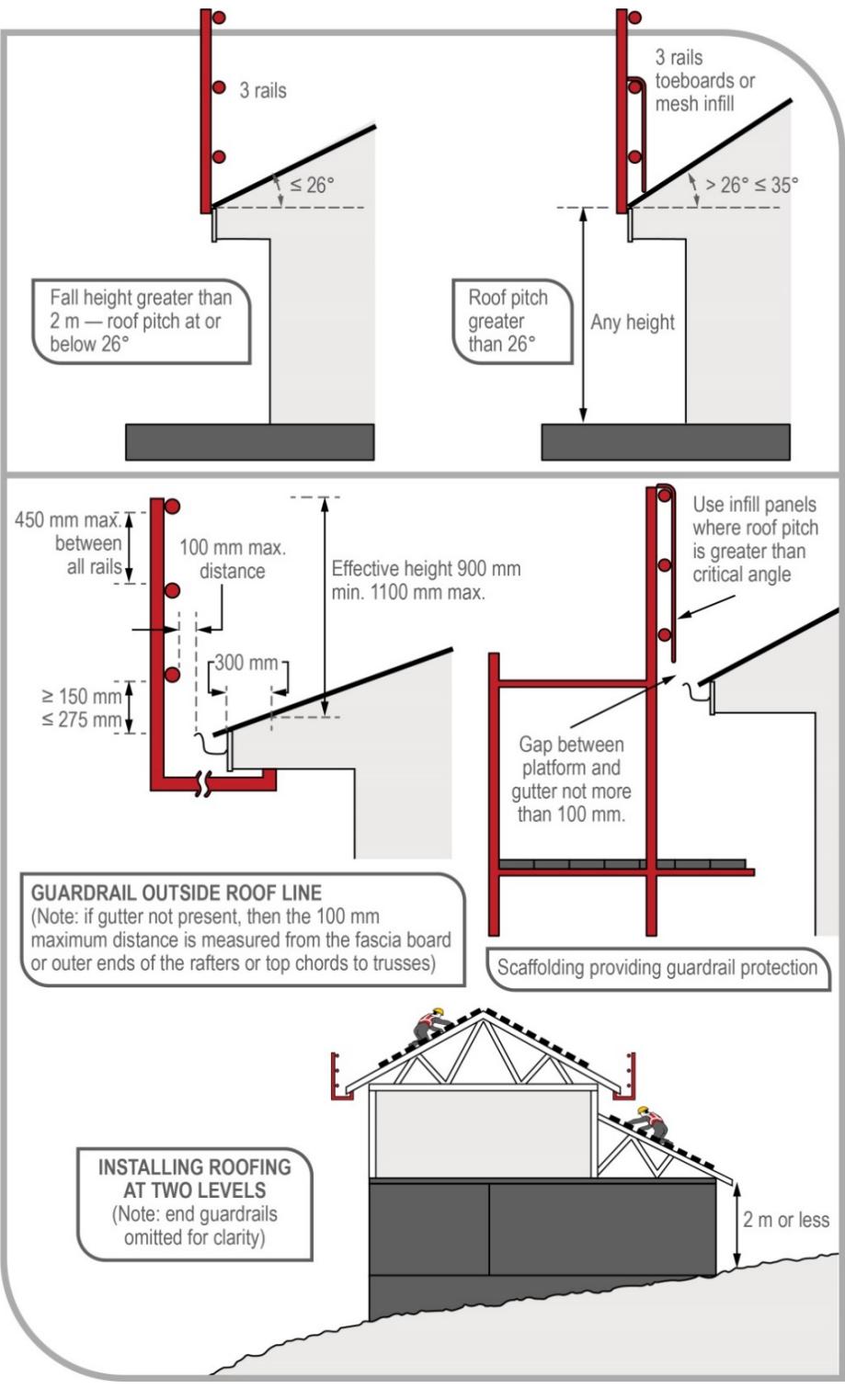 Figure 7 — Roof guardrail spec: 900 mm effective height (300 mm in from edge for pitch > 10°), gaps ≤ 275 mm, toeboard. Catch platform ≤ 500 mm below edge for pitch > 26°.
Pitch thresholds
- ≤ 10°: walk-able with edge protection.
- ≤ 26°: walk-able with edge protection. Wet/slippery may downgrade.
- > 26°: infill panels + catch platform ≤ 500 mm below; or work positioning.
- > 35°: don't stand. Use roof ladders, scaffold platform + work positioning.
Anchor points
- Purpose-designed roof anchors rated for the system (restraint vs arrest — different ratings).
- Timber roof anchorages are weak; fall-arrest needs ~6.5 m clearance — usually unavailable in housing. Restraint is preferred.
Harness types
- Restraint — short lanyard prevents reaching the edge. Preferred in housing.
- Fall arrest — only with verified clearance + energy absorber + rescue plan.
10. Scaffolds (housing-specific)
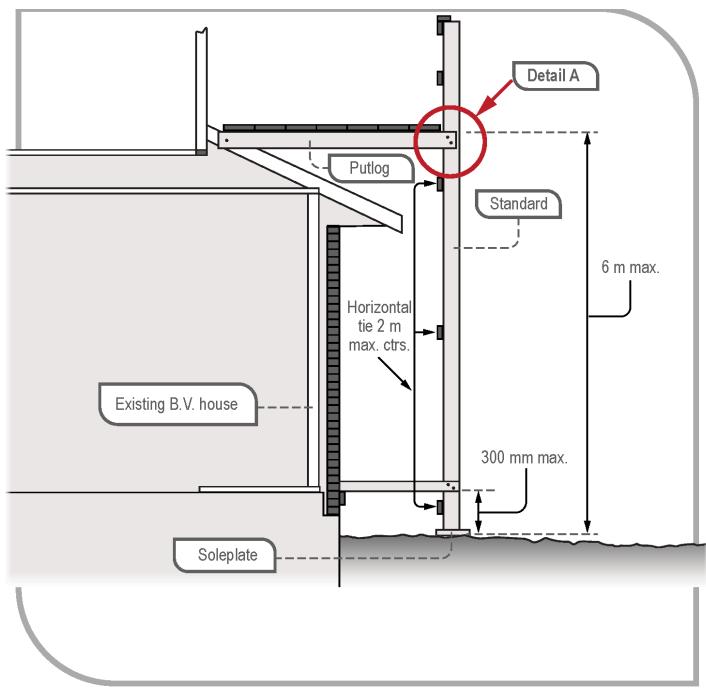 Figure 8 — Timber scaffold (single-pole, high first lift) — standard housing rig with putlog-to-standard fixings and bracing. Detail in Appendix C of the source code.
Types in housing: prefab tube-and-coupler / modular; trestles; mobile (scissor / boom); single-pole bracket; engineered timber.
Inspection cadence
- Before first use (competent person; written record if fall > 4 m possible).
- After alteration, repair, weather event (storm, impact).
- At least every 30 days if fall > 4 m possible.
- Tag system: green (safe), yellow (defects, do not use), red (hazardous, isolate).
Working platform width by duty
| Duty | Capacity / bay | Plank count |
|---|---|---|
| Light | ≤ 225 kg | ≥ 2 (≈ 450 mm) |
| Medium | ≤ 450 kg | ≥ 4 (≈ 900 mm) |
| Heavy | ≤ 675 kg | ≥ 5 (≈ 1000 mm) |
Planks: uniform thickness; butt-jointed (not lapped); secured against uplift; overhang 150–250 mm beyond putlogs.
HRWL needed if fall > 4 m possible during erection: basic / intermediate / advanced scaffolding licence.
11. Voids and stair openings
- Cover immediately after flooring laid — plywood or proprietary covers, rated (≥ 2 kN / 200 kg point load), secured.
- Use guardrails (900 mm top, mid, toe) for openings used as access.
- Internal safety nets for stairwells during truss erection.
- Signage: "DANGER HOLE BENEATH"; danger tags on incomplete scaffolds.
- During risky phases: layered protection (net + guardrail).
12. Records
- SWMS for any > 2 m fall risk — hazards, hierarchy, roles, emergency, induction.
- Scaffold register — design, erection date, inspection tags, certifications.
- Harness / fall-arrest log — purchase, maintenance, last inspection. If used in a fall, retire it.
- Training records — white card, work-at-height, harness/restraint, scaffold (HRWL).
- Anchor certifications — rated capacity, install date, competent-person sign-off.
13. Common pitfalls / quick wins
Do
- Audit every project for SWMS at >2 m work — no SWMS, stop work.
- Brace trusses every 3 m; assemble first two before subsequent ones.
- Install void covers immediately after the floor is laid — before any wall/roof work.
- Use trestle scaffold for any > 30-min task at height; ladder only for ≤ 10-min access.
- Erect perimeter guardrailing before roof assembly.
- Tag every scaffold > 4 m fall potential; inspect monthly; photograph tags.
- For pitch > 26°: catch platform or work positioning. For > 35°: stay off the roof.
Don't
- Use a ladder as a primary work platform.
- Erect trusses without bracing on partial wall plates.
- Leave stair voids open after flooring.
- Add an extra lift to a manufacturer-rated scaffold without engineering.
- Run scaffold over or near unguarded edges.
- Use timber roof anchors for fall arrest without clearance verification.
- Re-use a harness after a fall — destroy it.
14. Cross-references
- Generic falls (other industries / multi-storey): managing_risk_of_falls
- See also: general_construction_work, managing_risks_of_plant (Phase 3 — EWPs)
- Foundations: risk_management_process, whs_consultation_cooperation_coordination
- Glossary: glossary_and_key_concepts
Source: preventing-falls-in-housing-construction.md (Safe Work Australia, model Code of Practice, CC-BY-NC 4.0). Edition: October 2018. Last verified against SWA: 2026-04-27.