Demolition Work
Reverse-construct the structure in the order that keeps it standing until you tell it to come down. Most fatalities trace back to skipped pre-checks (asbestos, services, structural assessment).
- Demolition of any load-bearing structure is HRCW — SWMS required.
- Notify the regulator at least 5 days before demolishing a structure ≥ 6 m, using load-shifting plant on suspended floors, or using explosives (Reg 142).
- Identify or assume asbestos in any pre-Dec 2003 building before disturbance.
- Disconnect / cap services before work — gas, electricity, water, sewer, telecoms, steam.
- Maintain a 900 mm wall buffer above the floor below until that floor is cleared.
1. Who's responsible
PCBU with management/control of the workplace — primary duty (s.19). Often the demolition contractor, sometimes the principal contractor on a larger redevelopment.
Principal Contractor (if project ≥ $250k): WHS Management Plan must include the demolition arrangements, signage, security, induction.
Designer (where renovation/partial demolition triggers structural design changes): safety report on residual risks (Reg 295).
Asbestos removalist (Class A or B) — licensed where required.
Worker — comply with SWMS, hold required licences (HRWL for explosives, cranes, EWPs).
2. What counts as demolition + what's notifiable
Definition (WHS Act): work to demolish or dismantle a structure, or part of one, that is load-bearing or otherwise related to physical integrity. Excludes formwork, falsework, scaffolding removal and power/telecom-pole removal.
Notifiable to the regulator (Reg 142, ≥ 5 days before):
- Demolition of a load-bearing/integrity structure ≥ 6 m measured ground level to highest point.
- Demolition involving load-shifting plant on a suspended floor.
- Demolition using explosives.
Emergency services may notify as soon as reasonably practicable when responding.
3. Pre-demolition planning
Structural assessment
- Obtain the designer's safety report — flags structures where sequenced removal alters stability (limit-state design especially).
- If as-built docs are missing, fire-damaged, or deteriorated: commission a qualified structural engineer to investigate and report.
- Suspended-floor work with plant: certified assessment of floor capacity for static + live loads.
- Pre/post-tensioned concrete: high stored energy; competent person must assess tendon condition before any cutting.
Asbestos identification
- Identify ACM by competent person before any disturbance.
- Assume asbestos present in pre-Dec 2003 buildings, unaccounted parts, or where competent person is uncertain.
- Remove asbestos likely to be disturbed before demolition starts, so far as is reasonably practicable.
- Class A licence: any quantity / type (incl. friable, ACD).
- Class B licence: non-friable + associated ACD only.
- No licence: < 10 m² non-friable, or minor ACD.
- See §07 manage_and_control_asbestos and safely_remove_asbestos.
Other hazardous materials
| Material | Common location | Note |
|---|---|---|
| Lead | Paint pre-1978; plumbing pre-1978; ceiling dust 1923–1986 | Test; minimise dust; PPE; hygiene. |
| PCBs | Older capacitors, transformers | Polyethylene bags inside marked metal containers; nitrile/neoprene gloves. |
| Synthetic mineral fibres | Insulation | Identify; damp suppress; manufacturer guidance. |
| Mercury switches, oxyacetylene residues, pesticide residues | Various | Identify and plan removal. |
Essential services isolation
- All non-required electric, gas, water, sewer, steam and service lines shut off, capped or controlled at/outside the building line before demolition starts.
- Services kept live for the demolition: protect per the relevant authority.
- Underground services: Dial Before You Dig + pothole with hand tools / vacuum excavation if location uncertain. Electromagnetic locators / GPR acceptable if operators are competent.
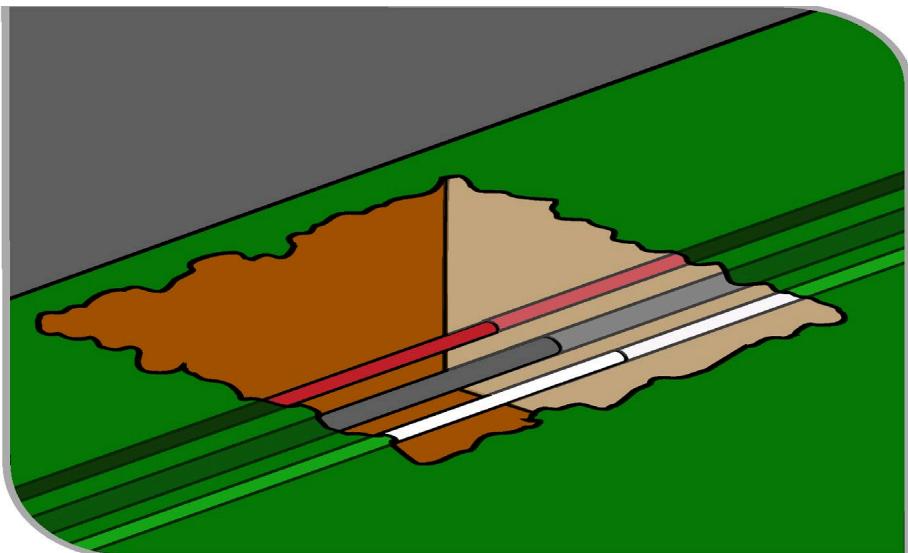 Figure 1 — Underground services exposed by potholing before mechanical excavation. Standard practice when location is uncertain.
4. Sequencing — reverse construction
General rule: demolish in the reverse order to construction (sequential demolition).
- Top-down for buildings; storey by storey for multistorey.
- Masonry/brickwork: course-by-course in even stages.
- Maintain structural stability throughout; add temporary bracing, propping, shoring, or guys.
- Modern limit-state structures may be less stable during demolition than in service — follow designer guidance.
- For pre/post-tensioned concrete: controlled tendon release; visual inspection, humidity in sheathing, selective testing.
900 mm rule: leave at least 900 mm of wall above the floor below as perimeter protection until that floor is cleared.
5. Methods — pick by structure and exposure
| Method | When | Critical control |
|---|---|---|
| Manual (jackhammers, sledgehammers, picks) | Only if mechanical not reasonably practicable; small-scale; intricate work near retained structure. | Demolish from safe platforms, never from top of wall being demolished. Don't cut reinforcement while concrete breaking continues. |
| Mechanical (excavators, cranes, loaders, bulldozers) | Most projects; FOPS + operator restraints required. | SWMS, traffic mgmt, debris removal, suspended-floor capacity verification. |
| Induced collapse (deliberate / controlled) | Detached, isolated structures on level sites with ≥ 1.5× height clear space. | Structural-engineer assessment; pre-weakening; no persons in strike zone; pulling distance ≥ 2× structure height. |
| Explosive | Only with regulatory approval. | Licensed competent person; blast management plan authorised pre-blast; comply with explosives legislation. |
Hand demolition of roofs: assess fragile materials, inspect for safety mesh, provide temporary walkways, secure cleats on high pitch (> 35°), provide roof ladders, fall protection.
Wall demolition: remove glass first; demolish from safe platform course-by-course; prevent lateral wind loads; maintain 900 mm above-floor buffer.
6. Hazards & controls
| Hazard | Primary controls |
|---|---|
| Falling objects | Exclusion zones, hoardings, gantries, debris drop zones, enclosed chutes (angled, secured, no jamming), signs at chute discharge. |
| Dust (RCS) | Water suppression; enclosed chutes; P2/P3 RPE for RCS; air monitoring near asbestos. |
| Noise & vibration | Cut rather than impact where feasible; isolate; acoustic enclosures; HPDs. |
| Mobile-plant collision | TMP, exclusion zones, comms (operator ↔ supervisor), wheel stoppers, no plant on/near uncertified buffer. |
| Structural collapse | Engineer assessment; temporary bracing; load-path analysis; daily inspection (post-rain, post-wind, post-tremor). |
| Public injury | Hoardings, gantries, road closures, signage, monitored entry/exit. AS 2601-2001 for security fencing & overhead protection. |
| Falls > 2 m | HRCW; SWMS; passive prevention (platforms, rails) before fall arrest. |
| Electrical | Disconnect live wiring before demolition; competent electrical engineer or supply authority renders safe. SWMS for any work near energised installations. |
| Fire & explosion | Remove flammables; assess in pre-demolition survey; maintain fire equipment; for hot work — wet down or fireproof blanket, fire spotter. |
| Tendon energy release | Competent-person controlled removal; restraint plates at pedestrian areas. |
7. Public protection
- Hoardings erected before work starts; security fencing + containment sheets/mesh.
- Gantries for any public walkway; designed to load-rated standards.
- Exclusion zones horizontally beyond overhead work; ground-anchored if wind/impact loads.
- Signage — PC name, 24/7 contact, office; hazard warnings (falling debris, fragile roof, electrocution).
- Daily inspection of hoarding/gantry condition; re-set after wind/impact.
8. PPE
- Respiratory: P2 minimum for general dust; full-face for asbestos disturbance (per safely_remove_asbestos).
- Eye/face: safety glasses; face shield for cutting/grinding.
- Hearing: plugs/muffs (demolition routinely > 85 dB).
- Hand: cut-resistant gloves; chemical-resistant for PCB/lead handling.
- Foot: steel-cap, non-slip.
- Head: hard hat; bump cap for low clearance.
- Body: hi-vis; flame-resistant if hot work.
- Fall protection: harness + lanyard + competent-assessed anchor.
9. Records
| Record | Note |
|---|---|
| Demolition plan | Location, height, structural type, methods, debris handling, sequence, hoardings, services, asbestos, adjacent buildings, emergency arrangements. |
| Structural / engineer report | Required if as-built docs missing or structure compromised. |
| Asbestos register + clearance certificate | Pre-existing register; licensed-removalist clearance after work. |
| Services-isolation record | Utility approvals, locations, dates. |
| SWMS (all versions) | Until HRCW complete + 2 yrs if incident. |
| Permits / licences | Asbestos Class A/B; HRWL for plant; explosives licence. |
| Plant-inspection logs | FOPS, ROPS, restraints, load-shifting. |
| Traffic management plan | Where public access nearby. |
| Underground services info | Until excavation complete; 2+ yrs if incident. |
| Incident records | Min 2 yrs. |
10. Common pitfalls / quick wins
Do
- Assume asbestos in pre-1980s buildings; engage licensed removalist early.
- Pothole before any excavation near services.
- Get an engineer's report when as-built docs are missing.
- Inspect hoarding daily; reset spotters during high-risk operations.
- Maintain the 900 mm wall buffer until the floor below is cleared.
- Take post-rain / post-wind structural inspections seriously, especially on tensioned/masonry/chimney work.
- Run a toolbox talk every shift on exclusion zones, emergency procedures, day's hazards.
Don't
- Proceed without an asbestos check just because there's no register.
- Mechanically excavate near services without an electrician/locator on site.
- Remove perimeter walls before upper floors are destabilised — kills the lateral support.
- Overload suspended floors with debris + plant + watered rubble.
- Manually demolish a roof without fall protection — falls > 2 m is HRCW.
- Use explosives without regulator approval.
11. Cross-references
- See also: general_construction_work, excavation_work, safe_design_of_structures
- Asbestos: manage_and_control_asbestos, safely_remove_asbestos (Phase 4)
- Falls: managing_risk_of_falls
- Foundations: risk_management_process
- Glossary: glossary_and_key_concepts
Source: demolition_work.md (Safe Work Australia, model Code of Practice, CC-BY-NC 4.0). Edition: October 2018. Last verified against SWA: 2026-04-27.